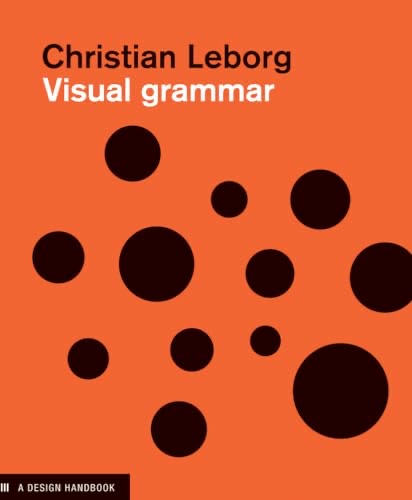
Cover of Visual Grammar

Visual Grammar

Christian Leborg

3 ideas

  1. Abstract Versus Concrete Visual Objects

    Every visual element is either abstract (a pure geometric form like a point, line, or plane with no reference outside itself) or concrete (a representation of something recognizable in the real world). Classifying an object along this axis determines how a viewer reads it — as structure and relationship, or as depicted content.

  2. The Point As Position Without Dimension

    A point marks a position in space and has no measurable dimension; it becomes a line only when it moves or repeats in sequence. This makes the point the irreducible origin of all visual form — every line, plane, and volume is built from the relationship between points.

  3. Meaning Emerges From Relationships Between Elements

    Visual significance is not located in an isolated object but in its relations to others — through contrast, similarity, proximity, repetition, rhythm, and direction. Reading a composition means decoding these relationships rather than cataloging the individual parts.

Save and mark ideas in the app