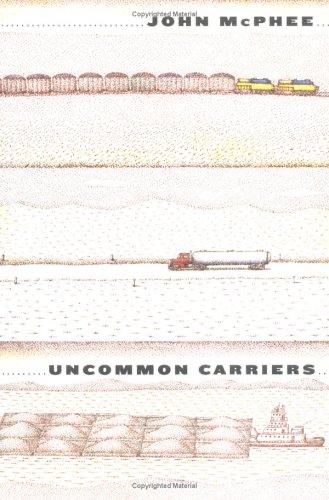
Cover of Uncommon Carriers

Uncommon Carriers

John McPhee

4 ideas

  1. The road train as a closed economic system

    A long-haul truck operates as a self-contained business where the driver is simultaneously laborer, pilot, and small entrepreneur whose margin depends on fuel efficiency, route choice, and weight distribution down to the pound. Optimizing the whole machine matters more than any single component because the costs compound continuously across thousands of miles.

  2. Reading terrain through the demands of cargo

    Geography looks entirely different to someone moving freight: a river is a grade and a current to be fought, a mountain pass is a fuel-burn calculation, a city is a chokepoint. Watching how transporters perceive the landscape reveals that physical space is experienced as a set of resistances and costs rather than as scenery.

  3. Mastery shows up as preemptive correction

    Expert operators of large, momentum-heavy vehicles act on threats long before they materialize, adjusting speed and position for hazards that may be a mile away because correction after the fact is impossible at scale. Skill in these domains is therefore measured not by reaction time but by how far ahead the operator is thinking.

  4. Piloting coal barges on the inland rivers

    A towboat captain pushing acres of lashed barges down a winding river must begin a turn far upstream, steering a rigid mass that responds with enormous delay and cannot stop. The episode illustrates how moving vast quantities cheaply requires sacrificing maneuverability, making patience and foresight the core competencies of bulk transport.

Save and mark ideas in the app