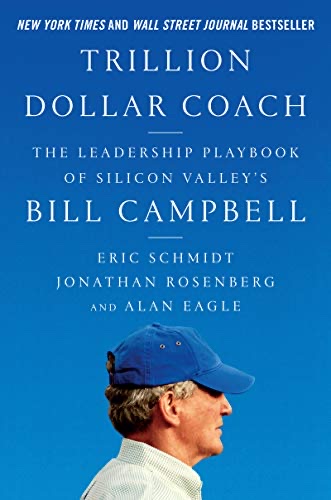
Cover of Trillion Dollar Coach

Trillion Dollar Coach

Eric Schmidt, Jonathan Rosenberg, Alan Eagle

5 ideas

  1. People First, Then the Problem

    Begin every one-on-one and team meeting with personal check-ins and trip reports before diving into business, treating the human relationships as the foundation that makes the work function. The premise is that people are the bedrock of any company's success, so a manager's primary job is the well-being and growth of their reports, not the tasks themselves.

  2. Don't Stick It in Their Ear

    Effective coaching withholds the answer even when you know it, instead asking questions that lead the person to discover the solution themselves so they own it and build judgment. Telling people what to do creates dependency, while questioning builds their capacity to decide on their own.

  3. Tension Is Resolved by Forcing Decisions

    When teams stall in unresolved debate, the coach's role is to identify the central tension and force the group toward a decision rather than letting consensus rot, often by getting the right people in a room to surface and argue the real disagreement. Lingering indecision is more damaging than a firmly made wrong call that can be corrected.

  4. The Team Is the Unit That Wins

    Before solving any problem, identify whether the right team is assembled to address it, because the durable solution comes from the team's composition rather than from the individual leader's brilliance. Fixing the team often matters more than fixing the immediate issue, since the same team will face the next problem too.

  5. Bill Campbell Coaches Google's Leadership Team

    Bill Campbell, a former Columbia University football coach who became CEO of Intuit, was brought into Google in 2001 at John Doerr's urging to coach Eric Schmidt and later attended Google's weekly staff meetings for roughly fifteen years. He was never paid and took no stock. He also coached Steve Jobs at Apple, where he sat on the board, as well as Larry Page and many other Silicon Valley leaders, until his death in 2016. The authors were three Google executives he coached, and they built the book from his methods, arguing his coaching helped create over a trillion dollars in company value.

Save and mark ideas in the app