Carroll's text through a new artist's eye
Maggie Taylor pairs Lewis Carroll's classic with her own dreamlike digital images. The book is a visual reinterpretation, letting a contemporary artist re-author a canonical tale.
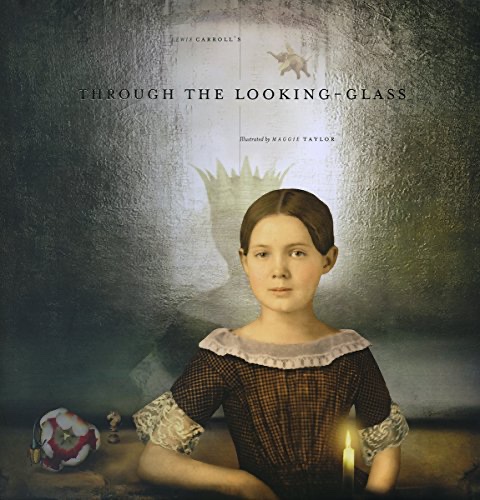
An illustrated edition of Lewis Carroll's nonsense tale, pairing the text with Maggie Taylor's surreal digital photomontages that treat the pictures as independent artwork.
Maggie Taylor pairs Lewis Carroll's classic with her own dreamlike digital images. The book is a visual reinterpretation, letting a contemporary artist re-author a canonical tale.
Taylor composites scanned objects and vintage photographs into surreal scenes on the computer. Her method shows illustration migrating from drawing to layered digital collage.
Carroll's logical nonsense finds a visual counterpart in Taylor's uncanny, floating imagery. The pairing argues that dream-logic writing calls for dream-logic pictures.
The images stand as fine art rather than subordinate captions to the story. Taylor asserts the illustrator as co-creator with a distinct vision.
Humpty Dumpty tells Alice that 'glory' means 'a nice knock-down argument' and, when she objects, says a word 'means just what I choose it to mean,' because the question is 'which is to be master.' He then boasts of paying words extra when he makes them 'do a lot of work,' yet his private meanings leave Alice unable to follow him at all. The episode is a concrete test case for whether meaning can be set by one speaker's will, or whether it depends on what the listener shares with him.
The Red Queen drags Alice into a furious run and they end up exactly where they started, because 'here, you see, it takes all the running you can do, to keep in the same place.' The mechanism is a moving baseline: when the surroundings advance as fast as you do, effort that looks like progress only keeps you from falling behind. To actually get somewhere you must run twice as fast.
The White Queen offers Alice 'jam every other day,' then explains the rule as 'jam to-morrow and jam yesterday — but never jam to-day.' Because the reward is tied to a time category that the present can never belong to, the promise is always valid and never paid out. The trick lies in the wording of the terms, not in any failure to deliver.
The White Knight explains that the name of his song is called 'Haddocks' Eyes,' the name itself is 'The Aged Aged Man,' the song is called 'Ways and Means,' and the song itself is 'A-sitting On A Gate.' Pulling apart four levels (what a name is called, the name, what the thing is called, and the thing) shows how many puzzles come from confusing a label with what it labels. The same lens applies to the Tweedles' claim that Alice exists only in the Red King's dream, where the reasoning slides between a description and its object.