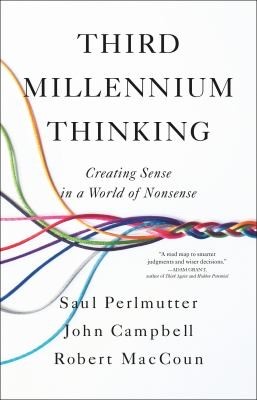
Cover of Third Millennium Thinking

Third Millennium Thinking

Saul Perlmutter, John Campbell, Robert MacCoun

6 ideas

  1. Probabilistic Confidence Calibration

    Express beliefs as probability ranges rather than binary certainties, then track whether your stated confidence matches your actual hit rate over time. A well-calibrated person who says '70% sure' should be right about 70% of the time across many such judgments, exposing both overconfidence and false modesty.

  2. Blind Analysis Against Self-Deception

    Researchers analyze data while hiding the final result from themselves — for example by adding a secret offset — so they cannot unconsciously stop adjusting once numbers match their expectations. Only after the analysis method is locked do they 'unblind,' which prevents the desired answer from steering the process.

  3. Signal Versus Noise Distinction

    Any measurement contains both a real underlying effect and random fluctuation, and mistaking noise for signal produces false discoveries that vanish on replication. The key skill is asking whether an apparent pattern is large enough relative to the expected scatter to be more than chance.

  4. Separating Facts From Values In Decisions

    Most contested decisions blend empirical questions (what will happen if we do X) with value questions (what outcomes we care about), and conflating them creates fake disagreements. Untangling the two reveals that opponents often agree on facts but differ on priorities, or share values but dispute predictions.

  5. Steelmanning As Trust Calibration

    Rather than trusting or distrusting a source wholesale, evaluate specific claims by reconstructing the strongest version of an opposing argument and checking whether your position survives it. This shifts the question from 'whose side are they on' to 'how well does this claim hold up,' making expertise judgments more granular.

  6. Scientific Habits As Civic Tools

    The reasoning practices that make science reliable — quantifying uncertainty, seeking disconfirming evidence, distinguishing correlation from cause — are learnable habits that ordinary citizens can apply to everyday claims and public debates. Treating these as general-purpose thinking tools, not specialist techniques, is presented as essential for navigating an information-saturated society.

Save and mark ideas in the app