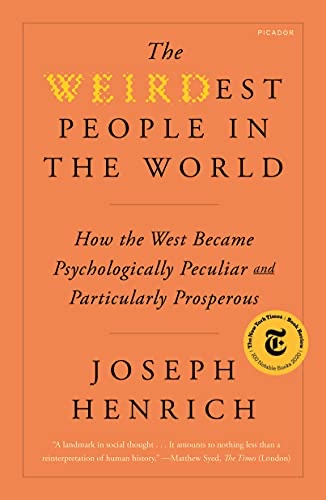
Cover of The Weirdest People in the World

The Weirdest People in the World

Joseph Henrich

10 ideas

  1. Kinship Intensity Predicts Psychology

    The structure of family systems — cousin-marriage rates, polygamy, clan organization, and co-residence — can be measured to create a 'kinship intensity index' that predicts a population's psychological traits. Tighter kinship correlates with greater conformity, in-group loyalty, and nepotism; looser kinship correlates with individualism, impartiality, and trust in strangers.

  2. Culture Reshapes the Brain and Biology

    Cultural practices physically alter human biology and neural wiring: learning to read, for instance, thickens the corpus callosum, relocates facial recognition, and degrades certain visual memory. Psychology is not fixed by genes but is partly constructed by the cultural skills and institutions a person grows up inside.

  3. Impersonal Prosociality vs. Interpersonal Bonds

    Trust and cooperation come in two distinct flavors: loyalty toward known relationships and in-groups, versus fairness and trust extended to anonymous strangers governed by abstract rules. WEIRD societies trade thick relational bonds for the impersonal prosociality that allows markets, voluntary institutions, and large-scale cooperation among strangers to function.

  4. Psychology Drove the Rise of Modern Institutions

    Markets, impartial law, representative government, and scientific innovation did not simply create new minds — rather, shifts in psychology toward individualism, analytical thinking, and impersonal trust made these institutions possible and sticky. Economic and political modernization is downstream of cultural-psychological change, not just material conditions.

  5. Intensive Kinship as Psychological Environment

    Intensive kin-based institutions include cousin marriage, clans, co-residence of extended families and corporate ownership by lineages. They reward conformity, deference to elders, in-group loyalty and shame-based morality, because survival depends on one's place in a dense web of inherited relationships. Where kinship intensity is low, people instead develop individualism, guilt-based morality and trust in strangers.

  6. Church Exposure Predicts Modern Psychology

    Henrich measures how many centuries each European region spent under the Western Church's marriage rules and finds that longer exposure predicts lower cousin-marriage rates and more individualistic, less conformist, more impersonally trusting psychology today. The same pattern appears across countries and even among second-generation immigrants, tracking their ancestors' kinship intensity.

  7. Church Marriage Programme Dissolved Kin Networks

    From roughly 500 CE the Western Church banned cousin marriage (eventually out to sixth cousins), polygamy, levirate marriage and adoption, and promoted neolocal residence and consensual marriage. These rules systematically broke up clans, lineages and extended kin groups across Europe. Individuals were pushed out of inherited kin obligations and into voluntary associations, which reshaped both social structure and psychology.

  8. Institutions Rewire Minds, Not Just Behaviour

    Culture shapes the brain as well as incentives: people adapt their cognition, including analytic versus holistic thinking, self-concept, and attention to intentions in moral judgment, to the institutions they grow up inside. So the psychology researchers treat as 'human nature' is largely a local product of institutional history. The book shows this with literacy thickening the corpus callosum and reshaping face recognition.

  9. Impersonal Prosociality Enabled Markets and Law

    Once kin ties weakened, people had to cooperate with strangers, so they built charter towns, guilds, universities, monasteries and impersonal markets governed by universal rules. Market integration further trained norms of fairness and trust toward anonymous others, creating a feedback loop. Individualist psychology plus these voluntary institutions laid the groundwork for representative government, contract law, science and Western economic growth.

  10. WEIRD Subjects Are Psychological Outliers

    Western, Educated, Industrialized, Rich, Democratic populations sit at the extreme tail of global variation on individualism, analytic thinking, impersonal prosociality, conformity and guilt-versus-shame. Because most psychology research samples them, the discipline has mistaken an unusual population for the human default. Findings from WEIRD samples therefore cannot be assumed to generalize.

Save and mark ideas in the app