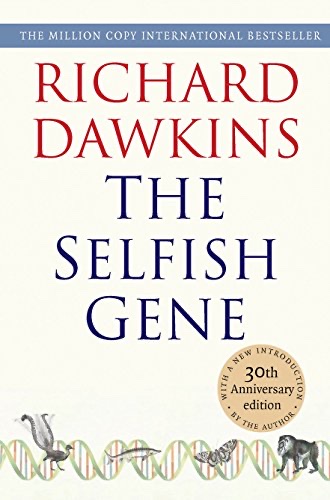
Cover of The Selfish Gene

The Selfish Gene

Richard Dawkins

7 ideas

  1. Selfish genes can build cooperation

    Apparent altruism and cooperation at the organism level emerge from genes acting in their own replicative interest. Self-interest at the gene level does not imply selfishness at the behavioral level — it can produce generosity, restraint, and reciprocal exchange.

  2. Reciprocal altruism among non-relatives

    Unrelated individuals can evolve to help each other when there is a reliable expectation of return, making mutual exchange pay off over repeated encounters. Stability requires the ability to recognize and exclude cheaters who take without giving back.

  3. Kin altruism follows shared-gene arithmetic

    A gene for helping relatives spreads when the benefit to the recipient, weighted by the probability they carry the same gene (relatedness r), exceeds the cost to the helper (Hamilton's rule, rB > C). Altruism toward kin is therefore gene-level selfishness, not a violation of it.

  4. Memes as cultural replicators

    A meme is a unit of cultural transmission, such as a tune, phrase, belief or fashion, that copies itself from brain to brain by imitation. Like genes, memes vary, get copied with differing fidelity and fecundity, and compete for limited resources (here, attention and memory). Memes that spread well persist whether or not they benefit their human hosts.

  5. Evolutionarily stable strategy resists invasion

    An evolutionarily stable strategy (ESS) is a behavioural policy which, once most of a population adopts it, cannot be outcompeted by any rare alternative strategy. In the hawk–dove game, neither pure aggression nor pure passivity is stable; the population settles at a mixed ratio where each strategy's payoff equals the other's. Stable social outcomes emerge from frequency-dependent payoffs, not from anything being best for the group.

  6. Group selection fails against individual cheaters

    Traits that benefit the group at the individual's expense, such as voluntary birth restraint, are unstable because a selfish mutant within the group reaps the shared benefit while outreproducing the restrained. Cheaters spread from within faster than group extinction can weed them out between groups. Apparent 'for the good of the species' behaviour must be explained by gene-level payoffs instead.

  7. Organisms as survival machines for genes

    Bodies are temporary vehicles built by replicators to carry them into the next generation; the gene, not the individual or species, is the unit that persists across generations and is therefore the unit selection acts on. Asking 'what benefits the gene copy?' rather than 'what benefits the animal?' dissolves puzzles like self-sacrifice, because a behaviour that kills the vehicle can still spread the genes it carries.

Save and mark ideas in the app