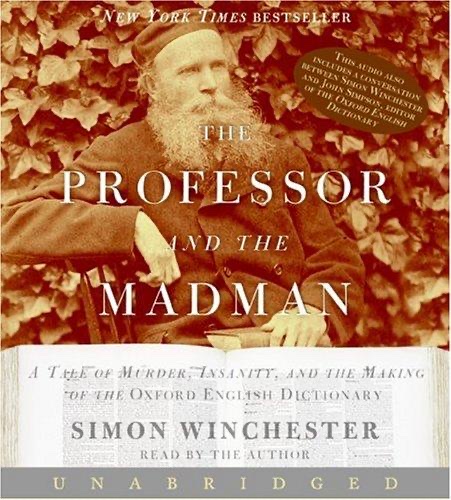
Cover of The Professor and the Madman

The Professor and the Madman

Simon Winchester

7 ideas

  1. Crowdsourcing meaning through documented usage

    The dictionary was built not by experts inventing definitions but by soliciting thousands of volunteers to read texts and mail in quotation slips showing each word used in context. Meaning was derived empirically from accumulated real-world evidence rather than prescribed from authority, letting the historical record of usage define the word.

  2. Mental illness can coexist with rigorous intellect

    Minor suffered severe paranoid delusions and self-mutilation yet simultaneously performed years of precise, systematic scholarly work at the highest level. The book argues that madness does not erase capability wholesale; a mind can be shattered in one domain while remaining exact and disciplined in another.

  3. A reference work as a multi-generational project

    The Oxford English Dictionary took some seventy years and outlived its original editors, functioning less like a single authored book than like a cathedral built across generations. Ambitious knowledge projects can require timelines longer than any individual career, demanding institutional continuity rather than heroic individual completion.

  4. Historical principles: define words through dated quotations

    The OED did not have editors write definitions from authority. Its entries were built from dated quotations that showed each sense of a word from its first recorded use through its later shifts in meaning.

  5. Asylum murderer becomes the OED's top contributor

    In 1872 William Chester Minor, a Yale-trained former U.S. Army surgeon suffering paranoid delusions, shot and killed George Merrett, a brewery worker, in Lambeth, London. He was found not guilty by reason of insanity and confined to Broadmoor Criminal Lunatic Asylum. After answering James Murray's public appeal for volunteer readers, he sent thousands of dated quotation slips from his cell over some two decades, becoming one of the dictionary's most valuable contributors, while his mental illness worsened to the point that he cut off his own penis in 1902.

  6. Obsessive scholarly work can channel madness without curing it

    Minor's isolation, unlimited time and compulsive meticulousness were products of his illness and confinement, and they were also what made him an ideal contributor to a vast, tedious reference project. The work gave him purpose, a connection to the outside world and possibly a way to atone for the killing. It did not stop his delusions or the escalation of his self-harm, so meaningful work eased his suffering but did not heal it.

  7. Demand-driven indexing beats indiscriminate volunteer submission

    Minor instead indexed every word in his own library in advance. He then asked the editors which letters and words they were currently working on and supplied exactly the quotations needed at that moment. His contributions were unusually valuable because he matched supply to the editors' real bottleneck, not because of the raw volume he sent.

Save and mark ideas in the app