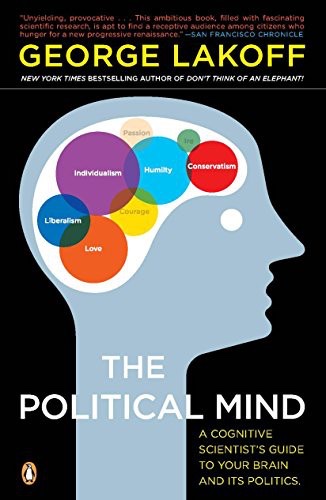
Cover of The Political Mind

The Political Mind

George Lakoff

6 ideas

  1. Reason Is Mostly Unconscious and Embodied

    About 98% of thought operates below conscious awareness, shaped by neural structures grounded in bodily experience rather than abstract logic. The Enlightenment model of humans as fundamentally rational, conscious, dispassionate calculators is empirically false, and political strategies built on it consistently fail.

  2. Frames as Neural Activation Structures

    A frame is a physical neural circuit that organizes how we understand a situation; words activate frames, and repeated activation strengthens them physically in the brain. Because frames are pre-installed, presenting facts that don't fit an existing frame causes the facts to be rejected rather than the frame revised.

  3. Strict Father vs. Nurturant Parent Models

    Political worldviews map onto two opposing family models: the Strict Father model prizes authority, discipline, and self-reliance, while the Nurturant Parent model prizes empathy, protection, and shared responsibility. Voters apply these family-based moral frames to the nation, and party allegiance follows from which model dominates a person's reasoning.

  4. Negating a Frame Reinforces It

    Saying a word evokes its frame even when you deny it, because negation cannot be processed without activating the concept being negated. Repeating an opponent's language to argue against it strengthens their frame in listeners' brains, so effective communication requires asserting your own frame rather than rebutting theirs.

  5. Biconceptualism in Political Minds

    Most people hold both the Strict Father and Nurturant Parent models active in different domains of life, applied to different issues. Political persuasion works by activating the desired model on a given issue and inhibiting the competing one, which is why narrowly targeted framing can shift the same person's stance across topics.

  6. Metaphor as Structured Inference

    Abstract concepts are understood through conceptual metaphors that import inference patterns from concrete physical experience, so 'morality is accounting' or 'a nation is a family' silently determine what conclusions feel logical. Whoever controls the governing metaphor controls which arguments seem natural and which seem absurd.

Save and mark ideas in the app