More options can reduce welfare
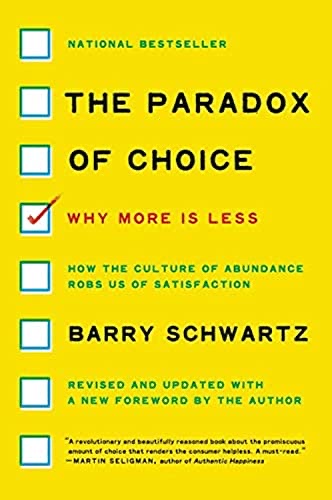
Beyond a point, adding choices raises the cost of deciding and the odds of regret, lowering satisfaction with whatever is chosen. Freedom of choice and happiness diverge.
9 ideas
Beyond a point, adding choices raises the cost of deciding and the odds of regret, lowering satisfaction with whatever is chosen. Freedom of choice and happiness diverge.
Schwartz argues that adding choice helps the poor in options but harms the option-saturated, so more is not always better. Constraints and defaults can protect well-being.
The mere expectation of future regret distorts present choices, pushing people to over-deliberate or avoid deciding. Emotion about the counterfactual governs behavior as much as the options themselves.
People quickly adapt to the pleasure of any chosen good, so its satisfaction fades. When a choice took great effort, the fading feels like a poor return on the investment. Wide choice also raises expectations of finding a perfect fit, so even good outcomes fall short of an inflated standard and produce disappointment.
Each option you forgo carries attractive features you have to give up. As alternatives multiply, these imagined losses add up and cut into satisfaction with whatever you chose. Trade-offs between options also create conflict and aversion, so the chosen option feels less good the more alternatives it beat.
Choose when to choose: make careful decisions only in the domains that truly matter, and satisfice or use defaults everywhere else. Make decisions nonreversible, practice gratitude for what you chose, and limit comparison with alternatives and other people. Treat constraints and voluntary rules as liberating, because fewer open decisions free attention and reduce regret.
Maximizers try to find the best possible option, so they search every alternative. Satisficers set a threshold of acceptability and stop at the first option that meets it. Maximizers often get objectively better outcomes, yet they feel worse about them: they report more regret, depression and perfectionism, and less satisfaction.
In a supermarket study by Iyengar and Lepper, a tasting table offered either 24 or 6 varieties of jam. The larger display drew more shoppers to stop and look. Only about 3% of them bought a jar, compared with about 30% at the six-jam display, which shows that abundant options attract attention but paralyze action.
When many options are available, a disappointing result can no longer be blamed on the world, only on the chooser's own choice. This shifts failure from the circumstances to the self. Schwartz argues that endless choice therefore feeds self-blame and helps explain rising rates of clinical depression despite material abundance.