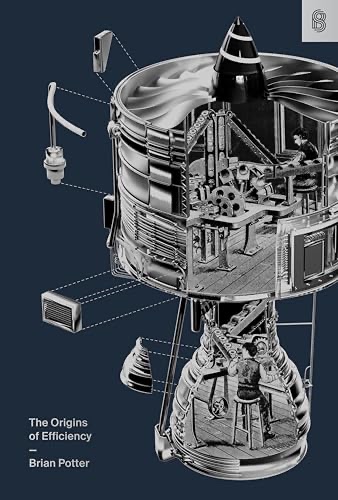
Cover of The Origins of Efficiency

The Origins of Efficiency

Brian Potter

6 ideas

  1. Interchangeable parts required precision before assembly

    Mass production of interchangeable parts only became possible once manufacturers could machine components to tight, consistent tolerances rather than hand-fitting each one. The bottleneck was never the assembly concept but the measurement and machining precision needed to make parts that fit without individual adjustment.

  2. Division of labor multiplies output via specialization

    Breaking a task into discrete sub-tasks performed by dedicated workers raises throughput because each worker develops speed at a narrow motion, eliminates time lost switching tools, and becomes a candidate for mechanization. The gains come not from working harder but from reducing setup, transition, and learning overhead per unit.

  3. Scientific management through measured time study

    Efficiency can be engineered by empirically measuring how long each elemental motion of a task takes, then redesigning the sequence to eliminate wasted movement and standardizing the optimal method. This treats work itself as an object of experimental study rather than something governed by tradition or worker discretion.

  4. Continuous flow beats batch processing

    Moving work continuously past stationary workers, rather than having workers move to stationary work in batches, slashes the time and inventory trapped between steps. The moving assembly line's gain comes largely from forcing a synchronized pace and eliminating the idle accumulation that batches create.

  5. Efficiency gains compound through accumulated small improvements

    Major productivity leaps usually look like single inventions in hindsight but are actually the aggregation of many incremental refinements to tooling, layout, and method. Viewing progress this way reveals that the durable advantage lies in a system that captures and retains improvements over time, not in any one breakthrough.

  6. Standardization as a precondition for scale

    Reducing variation in parts, processes, and outputs is what allows an operation to grow without proportionally growing complexity and coordination cost. Standardization makes work predictable, substitutable, and capable of being mechanized, which is why it consistently precedes any large jump in scale.

Save and mark ideas in the app