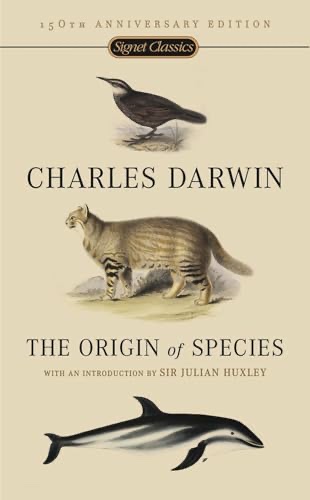
Cover of The Origin Of Species

The Origin Of Species

Charles Darwin

6 ideas

  1. Natural selection as the mechanism

    Because more offspring are born than can survive, individuals with heritable variations that aid survival and reproduction leave more descendants, so those traits accumulate. Darwin argues this simple filter, acting over immense time, produces adaptation and new species without a designer.

  2. Descent with modification from common ancestors

    All life forms a branching tree descending from few or one original forms, so similarities among species reflect shared ancestry rather than separate creation. Classification, embryology, and vestigial organs are explained as records of this genealogical descent.

  3. Analogy from artificial selection

    Darwin opens with breeders reshaping pigeons and crops in a few generations to make selection tangible, then argues nature does the same, only more slowly and thoroughly. Artificial selection supplies the visible proof of principle for its natural counterpart.

  4. Gradualism and deep geological time

    Evolution proceeds by the accumulation of countless slight variations, requiring vast stretches of time that the geological record only partially preserves. Darwin defends the incompleteness of the fossil record to explain missing intermediate forms.

  5. Struggle for existence and divergence

    Competition for limited resources among similar organisms drives divergence, as the most differentiated variants avoid direct rivalry and fill new niches. This principle of divergence explains why a single ancestor radiates into many distinct descendant species.

  6. Difficulties confronted honestly

    Darwin devotes chapters to the strongest objections, including the evolution of complex organs like the eye and instincts, answering each with graded intermediate cases. This method of anticipating and disarming counterarguments is central to the book's persuasive force.

Save and mark ideas in the app