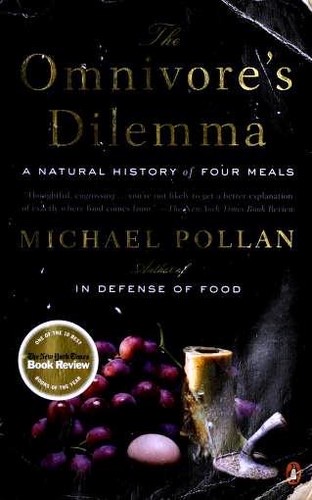
Cover of The Omnivore's Dilemma

The Omnivore's Dilemma

Michael Pollan

7 ideas

  1. Corn Underlies the Industrial Food Supply

    A vast share of processed food, sweeteners, and animal feed traces back to a single subsidized crop, making the modern diet effectively a corn-based monoculture in disguise. Isotope analysis of human tissue can reveal how much of our carbon literally comes from corn, exposing a hidden uniformity beneath apparent dietary variety.

  2. Trace the Meal Back to Sunlight

    Every food can be evaluated by following its energy chain backward to its original source, whether photosynthesis on grass or fossil fuel burned to make fertilizer and transport. This reveals that industrial food is partly a transformation of petroleum into calories, while pastured food converts solar energy more directly.

  3. Four Meals as Investigative Method

    Understanding a food system requires sourcing complete meals from each of its distinct chains—industrial, big organic, local-sustainable, and personally hunted-gathered—and following each ingredient to its origin. Comparing the full cost, energy, and ethics of each meal exposes tradeoffs invisible when eating without inquiry.

  4. The omnivore's dilemma of food choice

    A creature that can eat almost anything has to decide what is safe and nourishing, which means balancing attraction to novel foods (neophilia) against fear of poisoning (neophobia). Historically, culture resolved this through inherited cuisines and food traditions. When those traditions erode, people become anxious eaters who are easy prey for marketers and shifting nutrition fads.

  5. Polyface Farm's stacked grass-based rotation

    At Joel Salatin's Polyface Farm in Swoope, Virginia, cattle are moved daily to fresh paddocks of grass, and a few days later mobile 'Eggmobile' henhouses follow to eat fly larvae from the cow pats and spread the manure. The grass then recovers before the next grazing.

  6. Industrial organic follows industrial logic

    Trace an 'organic' label back to its source and big organic often looks like conventional agriculture with a different set of permitted inputs: monocultures, confined 'free-range' chickens with a token door, and lettuce trucked across the continent. The label certifies what was left out, not the ecological relationships that were meant to be restored. Following a food's full supply chain shows its real character better than the claims on the package.

  7. Cheap corn subsidies underwrite the industrial diet

    Federal farm policy pays farmers to maximize corn yields regardless of price, producing a chronic surplus that has to be disposed of somewhere. The surplus is absorbed by feedlot cattle, high-fructose corn syrup and processed-food additives, so that a fast-food meal turns out to be largely corn transformed. Overproduction therefore drives both the shape of the American diet and its calorie-dense, nutrient-poor character.

Save and mark ideas in the app