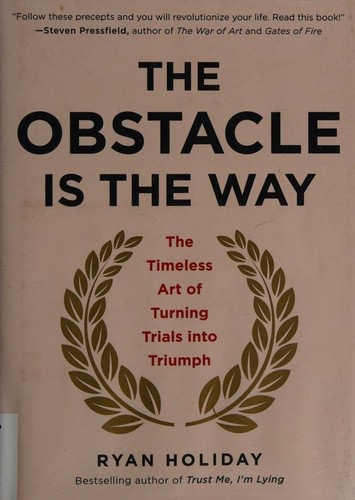
Cover of The Obstacle Is the Way

The Obstacle Is the Way

Ryan Holiday

6 ideas

  1. Perception, Action, Will Triad

    Every obstacle is overcome through three disciplines in sequence: controlling your perception so the obstacle appears as a neutral fact rather than a catastrophe, taking deliberate action to dismantle it, and exercising will to endure what cannot be changed. The three operate as a loop where perception determines what action is possible, and will sustains you when action runs out.

  2. Emotion Adds Nothing To Facts

    Events are objectively neutral; the distress comes from the judgments and labels you attach to them, not the events themselves. By separating the raw situation from your emotional interpretation, you can respond to what is actually in front of you rather than to an inflated story about it.

  3. The impediment to action advances action

    Taken from Marcus Aurelius, the idea is that an obstacle does not simply block a goal. It opens a different route, because meeting it forces you to use a virtue such as patience, ingenuity or courage. The mind turns the impediment into the material it works on, so what stands in the way becomes the way.

  4. Rockefeller's composure in the 1857 panic

    John D. Rockefeller began as a bookkeeper during the financial panic of 1857. Holiday presents him as someone who trained himself to stay calm and analytical while others panicked, and who read crises as chances to learn and to buy. Holiday's point is that coolness under market chaos is a trained perceptual habit rather than a matter of temperament, and that it becomes a lasting competitive advantage.

  5. Amor fati: love what happens

    Beyond accepting events you cannot change, Holiday argues you should embrace them as if you had chosen them. The will turns necessity into fuel rather than grievance. His examples include Edison watching his factory burn and treating it as a fresh start.

  6. Dichotomy of control as effort filter

    Following Epictetus, you sort every part of a situation into what is up to you (your judgments, choices and effort) and what is not (other people, outcomes, circumstances). You put all your energy into the first category and none into resenting the second. Effort spent on the uncontrollable is waste, and it also distorts judgment.

Save and mark ideas in the app