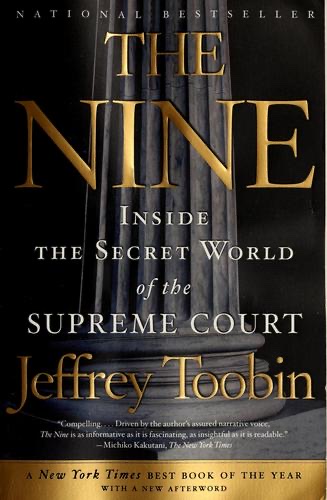
Cover of The Nine: Inside the Secret World of the Supreme Court

The Nine: Inside the Secret World of the Supreme Court

Jeffrey Toobin

6 ideas

  1. Justices Drift Left With Tenure

    Republican-appointed justices like Blackmun, Stevens, and Souter moved leftward over their careers because lifetime tenure frees them from political loyalty and exposes them to the persuasive culture of Washington and the Court. The absence of reelection pressure means a justice's actual values, rather than the views that got them appointed, eventually govern their votes.

  2. Constitutional Interpretation Tracks Public Opinion

    The Court rarely strays far from where mainstream American sentiment sits, deciding cases in ways that ratify shifts already underway in the broader culture rather than leading them. What appears as detached legal reasoning is often the Court catching up to a national consensus that has already formed.

  3. Bush v. Gore As Partisan Rupture

    The 2000 decision halting the Florida recount split exactly along the appointing party's lines, with the majority explicitly limiting its reasoning to that single case to avoid setting precedent. It demonstrates how the Court, claiming to apply neutral law, can hand a presidential election to one party while damaging its own institutional credibility.

  4. The Swing Justice As Pivot

    When the Court is otherwise evenly divided, a single centrist justice like O'Connor or Kennedy effectively becomes the entire law of the land, since their vote determines every contested outcome. Both lawyers and colleagues end up writing opinions aimed at persuading one person rather than building broad coalitions.

  5. Appointments As The Real Stakes

    Because justices serve for decades and shape policy across generations, the lasting prize of winning the presidency is the power to fill Court vacancies, making nominations more consequential than most legislation. Movements that organize patiently around judicial selection can reshape constitutional doctrine long after the appointing administration is gone.

  6. Doctrine As Personality And Relationship

    Major rulings emerge not from abstract logic but from the temperaments, friendships, rivalries, and persuasion among nine specific people sharing a building for life. Reading the Court through its human dynamics reveals that legal outcomes often hinge on who got along with whom and who could be moved.

Save and mark ideas in the app