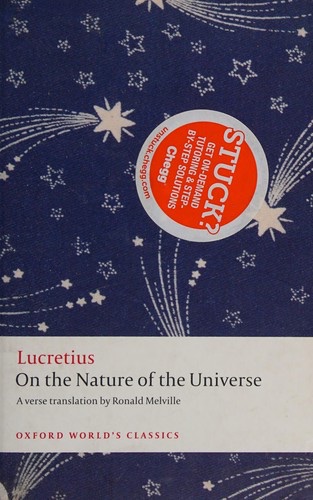
Cover of The Nature of Things (Folio Society)

The Nature of Things (Folio Society)

16 ideas

Buy on Amazon

A Latin philosophical poem presenting Epicurean atomism. Matter is atoms and void, the soul is mortal, and the gods are indifferent, so understanding nature frees people from fear. Folio edition, translated by Melville.

  1. Nothing Comes From Nothing

    Matter is never created from non-being nor destroyed into nothingness; if things could arise from nothing, any kind of thing could spring from any source at any time without seeds or seasons. Because we observe that specific things require specific origins and grow at fixed rates, there must be conserved indestructible material underlying all change.

  2. Indivisible Atoms and Void

    Reality consists of only two fundamental things: solid eternal particles too small to split further, and empty space through which they move. All apparent variety in the world is just different arrangements, motions, and combinations of these unchanging atoms within the void.

  3. The Clinamen or Atomic Swerve

    Atoms falling through the void occasionally deviate from their straight downward paths by a tiny, uncaused amount. This minimal swerve allows atoms to collide and form things, and it breaks the chain of mechanical determinism, leaving room for free will in living creatures.

  4. The Soul Is Material and Mortal

    Mind and spirit are made of especially fine, fast-moving atoms distributed through the body, not an immaterial essence. Because the soul is physical and dissolves when the body's atoms disperse at death, it cannot survive or feel anything afterward, so fear of punishment after death is groundless.

  5. Curing Fear Through Natural Explanation

    Human misery stems largely from fear of the gods and of death, both rooted in ignorance of how nature actually works. By demonstrating that physical phenomena have ordinary material causes rather than divine intervention, one removes the foundation of terror and achieves tranquility.

  6. Gods Indifferent to Human Affairs

    Even if gods exist, they live in perfect serene detachment and take no part in creating or governing the world or in rewarding and punishing people. Viewing the cosmos this way means storms, plagues, and disasters are natural events, not signs of divine anger to be appeased.

  7. Indivisible Atoms In Void

    All things are composed of solid, eternal, indivisible particles moving through empty space, and nothing exists except these bodies and the void they move in. Without void there could be no motion, and without permanent solid units everything would have already dissolved into nothing across infinite past time.

  8. The Atomic Swerve

    As atoms fall through the void they occasionally deviate by the slightest, undetermined amount from their straight downward path. Without this swerve atoms would never collide to form anything, and it is the swerve that breaks the chain of mechanical fate and makes free will possible in living creatures.

  9. Fear Of Gods Causes Suffering

    Human misery is largely produced by terror of the gods and of divine punishment after death, fears rooted in ignorance of how nature actually works. Understanding that natural events have material causes — not divine wrath — dissolves this dread and is the real purpose of studying physics.

  10. Death Is Nothing To Us

    The soul is itself made of fine atoms that disperse at death, so consciousness ends entirely when the body dies. Since there is no one left to experience anything, death cannot be bad for the person who dies — to fear it is to imagine yourself still present at your own absence.

  11. Sensation As Material Films

    Perception works because objects constantly shed thin films of atoms that travel through the air and strike our sense organs, transmitting shape and color. This explains sight, dreams, and apparitions as physical impacts of real particles rather than messages from a spirit world.

  12. Nothing comes from nothing, nothing vanishes

    If things could arise from nothing, anything could be born from anything at any time, and there would be no fixed seeds, seasons, or species. The regularity of nature shows that everything is made from enduring material particles that are rearranged but never created or destroyed. Change is recombination of permanent atoms, not creation or annihilation.

  13. Atoms and void as sole reality

    Everything that exists is either indivisible bodies (atoms) or the empty space in which they move. Void is required because motion would be impossible if everything were packed solid. Every perceived quality, including color, taste, and warmth, emerges from the shape, arrangement, and motion of atoms that themselves lack those qualities.

  14. The mind is mortal matter

    Something that can be damaged by wine, disease, and injury cannot be immortal. When the body's container breaks, the soul's atoms disperse like smoke, and no subject survives to experience anything.

  15. Symmetry argument against fearing death

    Look back at the eternity before your birth: you felt no distress at not existing then. The time after death is a mirror of that prenatal nothingness, so it cannot be a harm either. Since harm requires a subject to suffer it, and death removes the subject, death is nothing to us.

  16. Natural explanation dissolves religious fear

    The terror people feel about gods, portents, and afterlife punishment comes from ignorance of the natural causes behind thunder, disease, earthquakes, and celestial motion. Once those phenomena are explained as atoms following natural laws, fear of divine intervention loses its basis. Understanding how nature works is therefore the cure for anxiety, not just a body of knowledge.

Save ideas and give them a thumbs up or down in the app