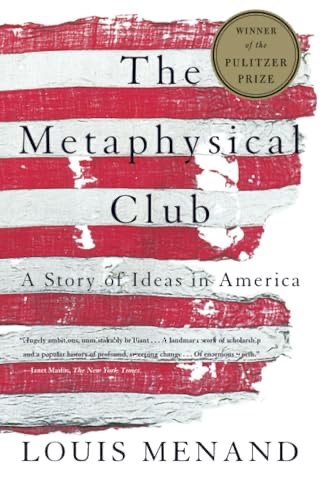
Cover of The Metaphysical Club

The Metaphysical Club

United States · 1861–1920

4 ideas

Buy on Amazon

A narrative intellectual history of American pragmatism, tracing how Holmes, James, Peirce and Dewey, shaped by the Civil War, came to treat ideas as tools and truth as what survives inquiry.

  1. Ideas as Tools, Not Mirrors

    Pragmatism holds that ideas are not representations of an external reality but instruments people develop to cope with their environment, much like forks or knives. Their value lies in what they enable us to do, not in how accurately they correspond to a fixed truth.

  2. Beliefs as Social, Not Solitary

    What we believe is produced by the groups and circumstances we belong to rather than by isolated individual reasoning, so thought is fundamentally a collective and contingent activity. This reframes truth as something arrived at through inquiry within a community rather than discovered alone.

  3. The Civil War as Intellectual Origin

    Oliver Wendell Holmes Jr. emerged from the carnage of the Civil War distrusting certainty itself, having watched abstract moral convictions drive men to slaughter. This experience seeded a generation's suspicion of fixed ideologies and a preference for provisional, testable beliefs over absolute principles.

  4. Truth as What Works Over Time

    A belief is 'true' not because it matches a pre-existing reality but because it proves useful and survives the test of consequences and ongoing inquiry. Truth is therefore mutable, plural, and earned through experiment rather than fixed in advance.

Save ideas and give them a thumbs up or down in the app