Enforced collective forgetting
On an unnamed island, categories of things, hats, birds, roses, periodically vanish, and the population's memory of them vanishes too. The state does not just ban objects; it erases the very capacity to recall them.
9 ideas
On an unnamed island, categories of things, hats, birds, roses, periodically vanish, and the population's memory of them vanishes too. The state does not just ban objects; it erases the very capacity to recall them.
As disappearances accelerate, even body parts and identity begin to dissolve, showing how a self is built from what it can remember. Ogawa treats erased memory as erased personhood.
The horror unfolds not through spectacle but through the islanders' calm, resigned compliance with each new loss. The novel argues that oppression works most completely when people stop noticing what is gone.
R. brings the narrator saved objects, such as a music box and a harmonica, hoping they will rekindle what she has lost, but she feels nothing when she holds them. Seen this way, memory is not stored in the artifact but in a living relationship with it. Preserving the things is not the same as preserving the meaning, and once that relationship is cut, the person who remembers cannot hand the memory back to the one who has forgotten.
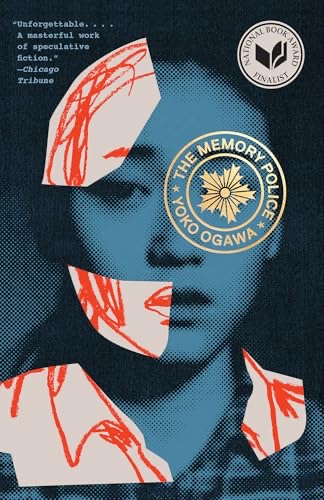
On an island where objects periodically 'disappear' from everyone's minds, an unnamed novelist learns that her editor, R., is one of the rare people who keeps his memories, which marks him for arrest by the Memory Police. With the help of an old ferry mechanic, she builds a hidden room beneath her floor and keeps him there for years. Meanwhile disappearances escalate from hats, birds, roses and photographs to novels and finally to body parts, until she dissolves into a voice and vanishes, and R. climbs out into a world that has forgotten her.
The Memory Police rarely destroy anything directly. When something disappears, residents burn, bury or throw away the remaining objects on their own, because the object no longer means anything to them. Enforcement is needed only at the edges, against the few who still remember, so most of the work of cultural erasure is done by ordinary people cleaning out what already feels empty.
Taking away one category at a time lets each disappearance feel small and bearable. The islanders adapt, burn the leftovers, and carry on until they finally lose their own bodies. Losses that are each tolerable can add up to complete erasure because no single step feels like the one to resist.
When a thing disappears on the island, what is lost is more than the object: the feelings, words, and skills attached to it go too, so people cannot even grieve what is gone. Forgetting of this kind cannot be seen from the inside, because the faculty that would register the loss is the thing that was removed.
The Memory Police do more than confiscate things. They make sure forgetting is complete by removing the people who still remember. The regime's power depends less on force than on the population's inability to recall that things were ever different. Anyone with intact memory becomes a crime, because memory is living proof that the present order is not natural.