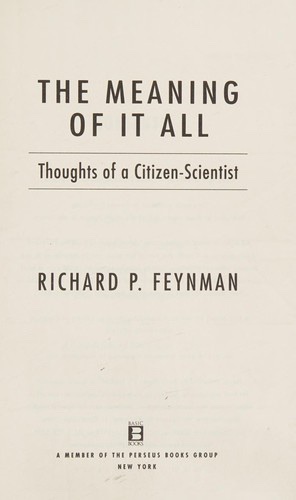
Cover of The Meaning of It All

The Meaning of It All

Richard P. Feynman

6 ideas

  1. Science Operates Through Degrees of Certainty

    No statement in science is known to be absolutely true; every proposition exists on a scale from very unlikely to very likely, never reaching perfect certainty. Treating knowledge as probabilistic rather than binary is what lets inquiry remain open and self-correcting.

  2. Doubt Is the Engine of Progress

    Permitting uncertainty and unsolved questions, rather than demanding final answers, is precisely what allowed science to advance where dogma stalled. The freedom to say 'I don't know' is not a weakness but the precondition for discovery.

  3. Testing Claims by Their Consequences

    A claim is judged scientific not by its source or appeal but by whether its specific predictions can be checked against experiment and could in principle fail. If a guess survives comparison with observation it is provisionally kept; if it disagrees, no amount of authority saves it.

  4. Science Cannot Determine Moral Values

    Science tells you what will happen if you do something, but never whether you should do it; questions of good and evil lie outside its method. The power science provides is a key that opens gates to both heaven and hell, with no instructions for which to choose.

  5. Wide Open Doors of Future Inquiry

    View the present state of knowledge as the early opening of countless unexplored doors rather than a near-complete picture, treating the mass of unanswered questions as the most exciting feature of any field. This reframing makes ignorance a frontier to celebrate instead of a deficiency to hide.

  6. Scientific Integrity as Reporting Against Yourself

    Honest inquiry requires actively seeking and publishing the evidence that could undermine your own conclusion, not just the data that supports it. Withholding the disconfirming case, even unintentionally, corrupts the result and deceives others who rely on it.

Save and mark ideas in the app