Four cases from Troy to Vietnam
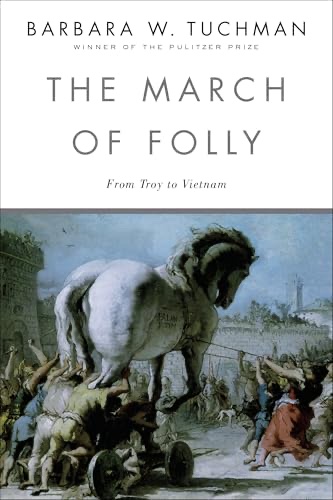
She traces folly through the Trojan horse, the Renaissance popes who provoked the Reformation, Britain's loss of America, and US escalation in Vietnam. Each shows rulers persisting against their own visible interest.
9 ideas
She traces folly through the Trojan horse, the Renaissance popes who provoked the Reformation, Britain's loss of America, and US escalation in Vietnam. Each shows rulers persisting against their own visible interest.
Tuchman argues power tends to breed a kind of mental standstill, insulating leaders from correction as responsibility grows. The higher the office, the greater the temptation to defend the original decision.
Her insistence on a contemporaneously available alternative refutes determinism, each folly could have gone otherwise. This makes the cases indictments of judgment, not fate.
Wooden-headedness is the refusal to benefit from experience. It shows up as judging a situation by preconceived fixed notions while ignoring or rejecting contrary signs, and acting on wishes instead of facts. It is a primary source of self-deception in government, and it grows with the security of power.
A policy counts as folly only if it was seen as counter-productive in its own time, not merely in hindsight. A feasible alternative course must also have been available. It must be the policy of a group or succession of rulers rather than one individual, so that it cannot be written off as personal eccentricity.
Six successive popes, from Sixtus IV to Clement VII, sold offices, pursued dynastic wars, and lived in extravagant venality. Contemporaries and reform councils openly demanded change. By ignoring these warnings for decades, the popes turned discontent into Luther's revolt and lost half of Western Christendom.
This lens reads policy disasters as failures to listen, not failures of information. In each case the warnings were voiced at the time by insiders or contemporaries. The useful diagnostic question is therefore not "what couldn't they know?" but "who was saying this, and why were they ignored?"
Once leaders have committed troops, money, and reputation to a course, admitting error feels costlier than persisting. So each new failure produces escalation rather than reassessment. Protecting the ego and the credibility of the policy-makers comes to outrank the interest the policy was meant to serve.
Successive British ministries insisted on Parliament's abstract right to tax the colonies, even though the revenue was trivial. Burke, Chatham, and others warned in Parliament that this would alienate a vital asset. Treating the principle of sovereignty as non-negotiable cost Britain the colonies it was trying to control.