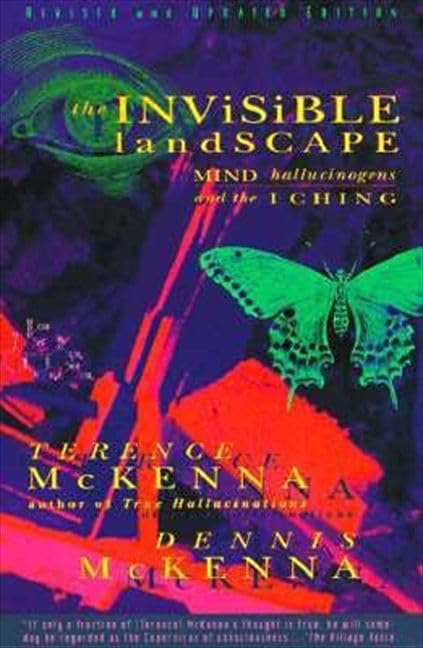
Cover of The invisible landscape

The invisible landscape

Terence McKenna

6 ideas

  1. Psychedelics open a hidden dimension of mind

    The McKennas argue that tryptamine hallucinogens grant access to real structures of consciousness normally invisible to waking cognition. Shamanic experience is treated as investigation of this landscape, not mere hallucination.

  2. Timewave theory and novelty

    The book advances a speculative theory that time has a fractal structure of ingressing novelty, derivable from the King Wen sequence of the I Ching. History is claimed to accelerate toward a singularity of maximized novelty.

  3. Molecular and shamanic bridges

    They propose links between the chemistry of neurotransmitters, DNA, and the visionary content of high-dose trance. Biology and myth are woven into a single speculative model of how altered states inform reality.

  4. Shamanism as an epistemology

    The authors treat the shaman as an early scientist of consciousness whose techniques yield knowledge inaccessible to ordinary observation. Ecstatic states become a method rather than a pathology.

  5. Language, sound and the visionary

    They argue that in deep tryptamine states, language becomes visible and objects can be beheld, suggesting a synesthetic layer where meaning takes form. This blurs the line between mind, word and world.

  6. A speculative unification of science and mysticism

    The Invisible Landscape deliberately fuses hard science, ethnobotany and esoteric numerology into one framework. Its ambition is a theory of everything spanning matter, mind and history, which it acknowledges is heterodox.

Save and mark ideas in the app