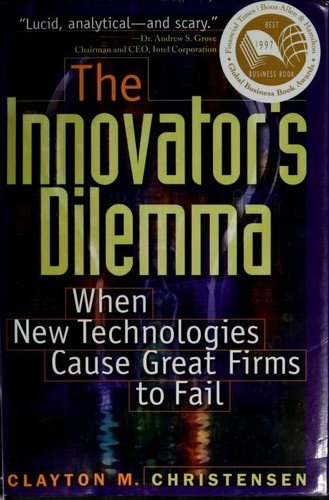
Cover of The Innovator's Dilemma

The Innovator's Dilemma

Clayton Christensen

6 ideas

  1. Sustaining Versus Disruptive Technologies

    Sustaining technologies improve product performance along dimensions that mainstream customers already value, while disruptive technologies initially perform worse on those dimensions but offer different attributes like cheapness, simplicity, or convenience. Incumbents reliably win sustaining battles because they are motivated to serve existing customers, but they lose to disruptions that take root in markets they consider beneath them.

  2. Good Management Causes Incumbent Failure

    Well-run companies fail not despite doing everything right but precisely because they listen to their best customers, invest in their highest-margin opportunities, and allocate resources to the largest markets. These rational, customer-focused decisions systematically steer firms away from low-margin, small, uncertain disruptive markets that later grow to displace them.

  3. Resource Dependence And Resource Allocation

    A company's real strategy is revealed not by managers' stated intentions but by where capital and effort actually flow, and that flow is dictated by customers and investors who supply the firm's resources. Projects that promise higher margins and serve known customers win internal competition for resources, making it nearly impossible to fund disruptive initiatives from within the mainstream organization.

  4. Performance Oversupply Opens The Door

    When the pace of technological improvement exceeds what customers can actually use, the basis of competition shifts from performance to reliability, then convenience, then price. This overshoot creates the opening for simpler, cheaper disruptive products to satisfy now-undemanding customers and capture the market from above.

  5. The Disk Drive Industry's Generational Wipeout

    Across successive shifts in disk drive size from 14-inch down to 1.8-inch, the dominant incumbents repeatedly developed the new smaller technology but failed to commercialize it because their existing customers had no use for it. New entrants who sold the smaller drives to emerging applications consistently overtook and destroyed the established leaders within a few years.

  6. Spin Out Disruptions Into Independent Units

    Because a disruptive opportunity cannot compete for resources or motivate effort inside an organization sized for large mature markets, the answer is to place it in a separate unit small enough to get excited by small wins. This independent organization should be matched to the size, cost structure, and customers of the emerging market rather than the parent's.

Save and mark ideas in the app