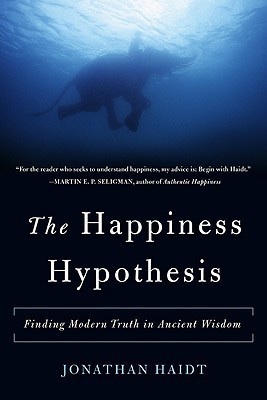
Cover of The Happiness Hypothesis

The Happiness Hypothesis

Jonathan Haidt

6 ideas

  1. The Elephant and the Rider

    The mind is divided into an automatic, emotional process (the elephant) and a controlled, reasoning process (the rider) sitting atop it. The rider can advise and nudge but cannot simply override the elephant by force, which is why willpower fails and why insight rarely produces behavior change without retraining the automatic system.

  2. Reason Is the Servant of Intuition

    Moral judgments arise first as gut intuitions, and conscious reasoning is then deployed afterward to justify the conclusion already reached. People rarely change their moral position through argument because they are defending a feeling, not a logically derived stance.

  3. The Three Levers of Lasting Change

    Because the emotional elephant resists direct willpower, durable personal change comes from three indirect interventions: meditation (calming the elephant), cognitive therapy (retraining its automatic thoughts), and medication like SSRIs (altering its chemistry). These work on the automatic system itself rather than relying on the rider's conscious effort.

  4. The Adaptation Principle and Happiness Setpoint

    Humans rapidly habituate to changes in fortune, so both windfalls and tragedies return us to a genetically influenced baseline level of happiness within months. This means chasing external conditions yields temporary gains, while the few things resistant to adaptation—like relationships and engaging work—are where lasting happiness lives.

  5. Adversity Can Produce Post-Traumatic Growth

    Significant hardship, when survived, often strengthens relationships, reveals hidden capabilities, and reorders priorities toward what matters—but only for people of a certain age and disposition, and only when meaning is constructed from it. The benefit comes not from the suffering itself but from the narrative coherence built afterward.

  6. The Happiness Formula H = S + C + V

    Lasting happiness equals one's biological setpoint (S) plus the conditions of life (C) plus voluntary activities (V). While the setpoint is fixed, certain conditions like good relationships and noise-free commutes genuinely matter, and voluntary activities offer the largest controllable lever because they resist adaptation.

Save and mark ideas in the app