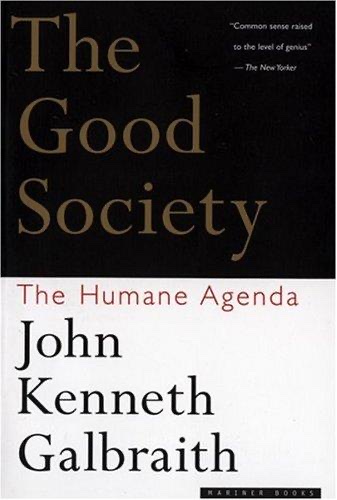
Cover of The Good Society

The Good Society

John Kenneth Galbraith

6 ideas

  1. Policy Is Driven by the Achievable, Not the Ideal

    The good society must be defined not by abstract perfection but by what is attainable given political and economic constraints. Demanding the unattainable discredits reform, so the practical agenda is the realistic agenda that improves outcomes within existing limits.

  2. Inflation Restraint Falls on the Powerless

    When governments fight inflation through restrictive monetary policy and high interest rates, the burden lands disproportionately on the unemployed and the poor rather than on those whose wage and price power caused the rise. The pain is socialized onto those least responsible and least able to bear it.

  3. Macroeconomic Performance Requires Active Demand Management

    A market economy left alone does not reliably produce full employment or stable growth; recessions and idle capacity persist without intervention. Government fiscal and monetary action to sustain aggregate demand is a permanent necessity, not an emergency measure.

  4. The Contented Electoral Majority

    In affluent democracies a self-satisfied majority who are doing well dominates voting, while the poor participate less and the disadvantaged are outnumbered. This produces policies that protect the comfortable and neglect the underclass, because political power tracks contentment rather than need.

  5. Migration as Economic Self-Correction

    Population movement from poor regions to rich ones is a rational economic response that benefits both migrants and receiving economies, not a threat to be sealed off. Viewing immigration as a labor-market equilibrating force reframes restriction as economically self-defeating.

  6. Education and Investment in Human Capability

    Public investment in education, health, and the capacities of the disadvantaged is the central instrument for breaking entrenched poverty and expanding productive participation. The good society treats spending on human development not as charity but as the foundation of sustained prosperity.

Save and mark ideas in the app