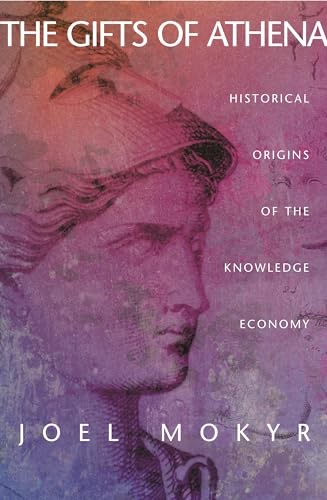
Cover of The Gifts of Athena

The Gifts of Athena

Joel Mokyr

6 ideas

  1. Propositional Versus Prescriptive Knowledge

    Knowledge splits into propositional knowledge ('what' — beliefs about natural phenomena and regularities) and prescriptive knowledge ('how' — techniques and instructions for production). Technology advances when prescriptive techniques draw on an expanding base of propositional understanding, so the two map onto each other like a feedback loop rather than evolving independently.

  2. Knowing Why Sustains Knowing How

    Pre-industrial economies generated occasional inventions, but these fizzled because no one understood the underlying principles, so techniques could not be improved, debugged, or extended. Sustained technological growth requires a wide enough propositional base (the 'epistemic base') that artisans can refine and recombine techniques rather than stumbling on them blindly.

  3. The Industrial Enlightenment

    Between the Scientific Revolution and the Industrial Revolution lay a movement to systematically catalog, classify, and disseminate useful knowledge, lowering the cost of accessing what was already known. Encyclopedias, professional societies, and public lectures connected those who understood natural phenomena with those who manipulated materials, bridging savants and fabricants.

  4. Access Costs Determine Knowledge Use

    What matters for an economy is not just how much is known but how cheaply that knowledge can be located, verified, and transmitted to those who can use it. Reducing access costs — through indexing, standardized notation, accessible journals, and trusted experts — can unlock economic growth even without any new discovery.

  5. Tightness and Trust in Knowledge

    A piece of propositional knowledge is 'tight' when there is widespread consensus that it is correct and confidence in its reliability. Tightness — established through demonstration, authority, or rhetorical persuasion — governs how willingly people will base costly techniques on a claim, so the social validation of knowledge is as economically decisive as its truth.

  6. Why China Stalled Despite Knowing Much

    China possessed sophisticated techniques and observations but lacked the institutional channels and cultural incentives to convert isolated know-how into a self-reinforcing epistemic base. Without competitive intellectual communities, open contestation of authority, and bridges between scholars and craftsmen, an accumulation of useful knowledge fails to ignite sustained growth.

Save and mark ideas in the app