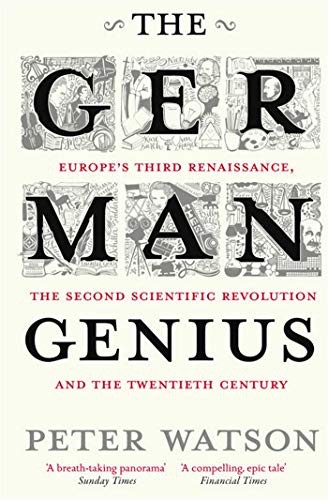
Cover of The German Genius

The German Genius

Peter Watson

6 ideas

  1. The 1933 Cutoff Distorts German Memory

    The Anglo-American world has allowed twelve years of Nazi rule to eclipse roughly two centuries of German intellectual achievement, so that 'German' now connotes Hitler rather than Kant, Beethoven, or Planck. This selective amnesia is a learned habit, partly sustained by wartime propaganda and education curricula, not an objective historical judgment.

  2. Bildung as Self-Cultivation Through Knowledge

    Bildung is the ideal of forming the whole person through inward intellectual and aesthetic development rather than through external status or vocational training. It treats education as a lifelong project of self-transformation, making the cultivated individual—not the productive citizen—the goal.

  3. The Research University as Knowledge Engine

    The German model pioneered by Humboldt fused teaching with original research and academic freedom, so professors generated new knowledge rather than merely transmitting received doctrine. The seminar and laboratory replaced rote instruction, making discovery itself the institution's core function and producing the dominance of German science and scholarship in the 19th century.

  4. Inwardness Substituted for Political Power

    Because Germans long lacked a unified state and political liberty, they channeled their energies into the inner life—music, philosophy, and metaphysics—producing extraordinary depth in art and thought. This 'cultural nation' compensated for the absence of a political nation, but it also bred a dangerous indifference to public institutions and practical politics.

  5. Reading Modernity as German-Authored

    Many defining structures of modern life—the PhD, the chemical and pharmaceutical industries, kindergarten, modern theology and historical criticism, sociology, quantum theory—originated in German-speaking lands. Viewing the modern world through this lens reveals an invisible German infrastructure underlying institutions usually assumed to be Anglo-American.

  6. High Culture Did Not Prevent Barbarism

    The same nation that produced the deepest philosophy, music, and science also produced Auschwitz, so cultural sophistication offers no immunity against moral catastrophe. The persistent puzzle is whether elements within German thought—romantic irrationalism, the cult of inwardness, contempt for liberal politics—actively enabled the disaster rather than merely failing to stop it.

Save and mark ideas in the app