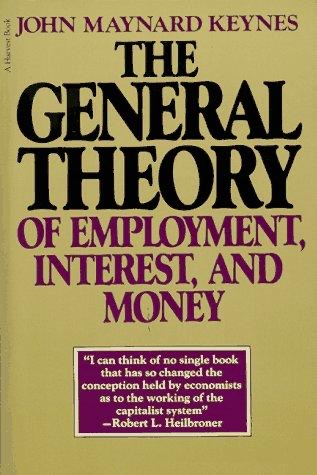
Cover of The General Theory of Employment, Interest and Money

The General Theory of Employment, Interest and Money

John Maynard Keynes

10 ideas

  1. The Marginal Propensity to Consume

    As income rises, consumption rises but by less than the full increase, because people save a growing fraction of additional income. This gap between income and consumption means that growth in income alone cannot guarantee enough spending to absorb all output, creating a persistent demand shortfall that must be filled by investment.

  2. The Investment Multiplier

    An initial increase in investment spending generates a larger total increase in income, because the recipients of that spending re-spend a portion (set by their propensity to consume) in successive rounds. The multiplier equals 1/(1 − marginal propensity to consume), so the smaller the leakage into saving, the larger the amplification.

  3. Liquidity Preference Sets the Interest Rate

    The interest rate is the price paid to overcome people's desire to hold wealth in liquid cash rather than illiquid bonds, driven by transaction, precautionary, and speculative motives. Interest is therefore a monetary phenomenon governed by money supply and the demand for liquidity, not the reward for abstaining from consumption.

  4. Saving and Investment Are Not Self-Balancing

    Saving is a residual decision made by households while investment is a separate decision made by firms responding to expected returns, so there is no automatic mechanism forcing the two into equality at full employment. When intended saving exceeds intended investment, income falls until saving is reduced to match — equilibrium can settle far below full employment.

  5. Animal Spirits Drive Investment Decisions

    Long-term investment depends on expectations about an unknowable future, so calculation gives way to spontaneous optimism — a 'spontaneous urge to action' rather than the weighted average of quantitative probabilities. Because these psychological waves of confidence are volatile and self-reinforcing, investment is inherently unstable and prone to sudden collapse.

  6. Paradox of thrift through the multiplier

    Run in reverse, if everyone tries to save more, spending and income fall until realised saving is no higher than before. Individual prudence can therefore produce collective impoverishment.

  7. State must socialise investment to secure employment

    Private investment cannot be relied on to keep demand at full employment, so government must take responsibility for the overall volume of investment and spending, using public works and deficits when private demand fails. This preserves private ownership and markets for allocating resources while correcting the aggregate level the market cannot stabilise on its own.

  8. Unemployment equilibrium from deficient effective demand

    Output and employment are set by the level of aggregate demand that firms expect, not by wage flexibility clearing the labour market. Because spending on consumption plus investment can fall short of what full-employment output would produce, the economy can come to rest at a stable equilibrium with persistent involuntary unemployment and no internal force pushing it back.

  9. Liquidity preference and the liquidity trap

    The interest rate is not the price that balances saving and investment but the reward for giving up holding cash, which people prefer as a hedge against uncertainty. When fear rises, the demand to hoard money can keep rates too high to spur investment. At very low rates, adding money may simply be absorbed into idle balances, so monetary policy loses traction.

  10. Stock market as a beauty contest

    Professional investors profit less by judging an asset's true long-term value than by anticipating what average opinion expects average opinion to be. This turns markets into a game of guessing other people's guesses. It makes speculation dominate enterprise, so prices can drift far from fundamentals and capital development becomes a by-product of a casino.

Save and mark ideas in the app