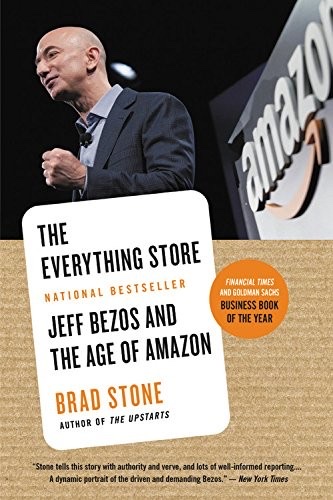
Cover of The Everything Store

The Everything Store

Brad Stone

8 ideas

  1. Get big fast at any cost

    Amazon prioritized market-share growth and scale over near-term profit, reinvesting relentlessly to lock in customers and crowd out rivals. Willingness to lose money for years became a competitive moat competitors could not match.

  2. The everything-store origin vision

    Bezos wanted a store selling every product, starting with books because their vast catalog and standard format suited online retail. Books were a wedge, not the destination.

  3. Customer obsession over competitor focus

    Amazon anchored decisions on customer benefit (selection, price, delivery) rather than reacting to rivals, treating relentless customer improvement as the durable strategy. This orientation justified sacrificing margins to lower prices.

  4. Culture of frugality and confrontation

    Bezos ran a demanding, cost-averse culture that tolerated interpersonal harshness in service of efficiency and truth-telling. High standards and confrontation were treated as features that protected the customer, not bugs.

  5. Selling your internal infrastructure creates new businesses

    Amazon Web Services grew out of rebuilding Amazon's own messy systems into separate internal services that talk to each other through defined interfaces. Once those services were standardized, they could be rented to outside developers with little extra work.

  6. Your margin is my opportunity

    Bezos treated any competitor's or supplier's profit margin as a subsidy to customers that Amazon could take by running on thinner margins. This explains moves that look irrational on a quarterly view: selling Kindle e-books at a loss, launching Prime's unlimited two-day shipping, and pressing publishers and rivals like Diapers.com. The strategy works only if investors accept long-term free cash flow over reported earnings, so the shareholder letters were written to recruit investors who would.

  7. Bezos leaves D.E. Shaw for Seattle

    In 1994 Jeff Bezos, a senior vice president at the quant hedge fund D.E. Shaw, read that web usage was growing about 2,300% a year and quit to sell books online, a category chosen for its millions of titles. He framed the choice as a 'regret minimization framework': at 80 he would not regret trying and failing, but he would regret not trying. He and MacKenzie drove west while he typed the business plan and revenue projections into a laptop, and they started the company in a Bellevue garage.
  8. The flywheel: self-reinforcing growth loop

    Lower prices bring more customers, more customers attract more third-party sellers and selection, and the added volume spreads fixed costs like warehouses and servers so prices can drop again. Because each part feeds the next, any push on one part speeds up the whole loop. That is why Amazon kept giving up margin whenever it could buy more momentum.

Save and mark ideas in the app