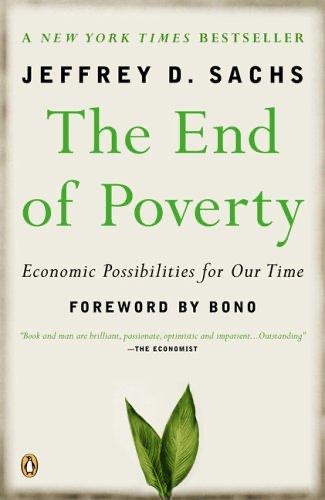
Cover of The End of Poverty

The End of Poverty

Jeffrey D. Sachs

6 ideas

  1. The Poverty Trap and the Bottom Rung

    The poorest people are stuck below the bottom rung of the development ladder because they lack the minimum capital — savings, infrastructure, health, education — needed to begin economic growth. Once income is entirely consumed for survival, there is nothing left to invest, so the economy cannot self-start and remains frozen without external help.

  2. Clinical Economics for Diagnosing Economies

    An economy should be diagnosed like a patient: a development economist examines multiple interacting systems — geography, governance, fiscal conditions, cultural barriers, trade — before prescribing remedies. Blanket prescriptions fail because each country's poverty has distinct causes requiring differential diagnosis rather than one-size-fits-all austerity.

  3. Targeted Investment Can End Extreme Poverty

    Extreme poverty can be eliminated within a generation if rich nations commit roughly 0.7% of GNP to well-targeted investments in health, agriculture, infrastructure, and education. The required sum is small relative to wealthy economies, making the problem one of political will rather than affordability.

  4. Geography as Economic Destiny

    A nation's physical conditions — being landlocked, disease burden like malaria, poor soils, lack of navigable rivers — impose structural costs that markets alone cannot overcome. Viewing underdevelopment through geography reveals barriers invisible to explanations based purely on policy or corruption.

  5. Bolivia's Hyperinflation Stabilization

    When Sachs advised Bolivia in 1985, hyperinflation running at thousands of percent was halted within weeks by stabilizing the currency and budget, demonstrating that monetary chaos could be reversed rapidly. Yet stabilization alone did not produce growth, revealing that taming inflation is necessary but insufficient for escaping poverty.

  6. Ladder of Development with Differentiated Aid

    Countries occupy different rungs of a development ladder, and aid should be calibrated to where they stand: the poorest need direct investment to even start climbing, while middle-income nations need trade access and market reforms. Treating all poor nations identically wastes resources by mismatching interventions to actual stage.

Save and mark ideas in the app