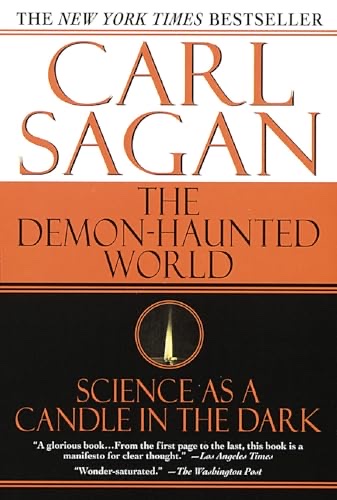
Cover of The Demon-Haunted World

The Demon-Haunted World

Carl Sagan, Ann Druyan

8 ideas

  1. Extraordinary Claims Require Extraordinary Evidence

    The strength of evidence demanded should scale with how much a claim contradicts established understanding. A mundane assertion can rest on ordinary proof, but one that overturns well-tested knowledge must clear a proportionally higher bar before acceptance.

  2. Science as a Candle in the Dark

    Treat scientific method not as a body of facts but as a self-correcting source of light against superstition, fear, and exploitation. Where this candle dims, demons — pseudoscience, charlatanism, and authoritarian deception — rush back to fill the explanatory vacuum.

  3. Alien Abductions as Recycled Demonology

    The modern accounts of nighttime visitations, paralysis, and reproductive interference by aliens mirror earlier reports of incubi, succubi, and demons almost beat for beat. The recurring structure suggests these experiences arise from common features of the human mind — sleep states, suggestion, and cultural narrative — rather than from external visitors.

  4. Catalogue of logical fallacies and rhetorical tricks

    Sagan's kit includes a list of named errors that make bad arguments persuasive. Among them are ad hominem attacks, appeals to ignorance (a claim is true because it hasn't been disproven), special pleading, begging the question, observational selection, the fallacy of small numbers, confusing correlation with causation, the false dichotomy, the slippery slope, and the straw man. Naming these patterns makes them easier to spot in advertising, politics, and your own reasoning.

  5. The invisible dragon in the garage

    Someone claims a fire-breathing dragon lives in their garage. Every proposed test is met with a special excuse: it is invisible, it floats, its fire is heatless, it leaves no footprints. A claim that is protected against every possible disproof is no different from no claim at all, so it deserves no belief.

  6. Science as balance of skepticism and wonder

    Good thinking holds two opposed dispositions at once. It needs ruthless skepticism, which filters out error. It also needs openness to new ideas, which lets genuinely surprising truths in. Skepticism alone makes you reject everything new, and openness alone makes you believe anything, so science is the discipline of combining them.

  7. The Baloney Detection Kit toolset

    Before accepting a claim, run it through a checklist of tests. Seek independent confirmation of the facts. Encourage open debate among knowledgeable people. Discount arguments from authority. Generate multiple competing hypotheses, and don't get attached to your own. Quantify wherever possible. Check that every link in a chain of argument holds, apply Occam's razor, and ask whether the claim is falsifiable at least in principle.

  8. Scientific illiteracy endangers democratic self-government

    A society that depends on science and technology, but whose citizens cannot evaluate scientific claims, leaves decisions to experts and demagogues it cannot check. Science's habits of error-correction, questioning authority, and demanding evidence are the same habits democracy needs. Without them, a public becomes vulnerable to superstition, pseudoscience, and manipulation.

Save and mark ideas in the app