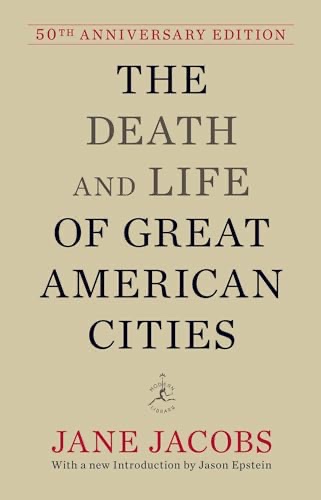
Cover of The death and life of great American cities

The death and life of great American cities

Jane Jacobs

8 ideas

  1. Urban renewal destroys living neighborhoods

    Slum-clearance, high-rise projects, and highways sever the fine-grained networks and street life that make places work, replacing them with sterile, unsafe superblocks. Jacobs shows top-down renewal repeatedly demolishing functioning communities in the name of improvement.

  2. Bottom-up order over master plans

    Vitality emerges from countless small, uncoordinated decisions rather than a planner's imposed blueprint. Jacobs reframes the city as an emergent order to be nurtured and observed, not a machine to be engineered from above.

  3. Eyes on the street as safety

    Streets are kept safe not by police but by an informal, continuous surveillance from people who have reasons to be there: shopkeepers, residents at windows, passers-by. This requires buildings oriented toward the street and a steady flow of users across the day, so that watching happens as a by-product of ordinary activity rather than as anyone's assigned job.

  4. Old buildings incubate new enterprises

    New construction carries high capital costs that only established, high-margin, or subsidised uses can pay, so a district of uniformly new buildings excludes experimental and marginal ventures. Aged, depreciated buildings provide the cheap space where new ideas, small businesses, and unusual uses can start, making building-age variety an economic necessity rather than a nostalgic preference.

  5. Cataclysmic money destroys what gradual money builds

    Large lump-sum investments like urban renewal and mass public housing wipe out neighbourhoods and replace them all at once, while credit blacklisting (redlining) starves existing districts of the small, incremental loans they need to improve. Healthy districts evolve through gradual money spread across many owners, so financing patterns rather than intentions determine whether places decay or regenerate.

  6. Four generators of urban diversity

    A district generates vitality only when four conditions hold together: mixed primary uses that bring people out at different times of day, short blocks that multiply route choices, buildings of varied age and condition so low-yield enterprises can afford space, and a sufficiently dense concentration of people. Each condition is necessary; removing any one collapses the diversity the others would produce.

  7. The Hudson Street sidewalk ballet

    Jacobs describes her own Greenwich Village block through a day: the morning exodus, shopkeepers opening up, lunchtime crowds, children returning, evening strollers, late-night bar patrons. This intricate, unchoreographed sequence of overlapping presences produces order, safety, and neighbourly trust without any central design, illustrating how street life self-organises from many independent routines.

  8. Cities as problems of organised complexity

    Cities are neither simple two-variable problems nor statistical averages of disorganised complexity, but systems of many interrelated factors that adjust to one another into an organic whole. Planning that treats them with simple or statistical methods, isolating one variable like housing density or traffic, misreads how they work and destroys the interdependencies that make them function.

Save and mark ideas in the app