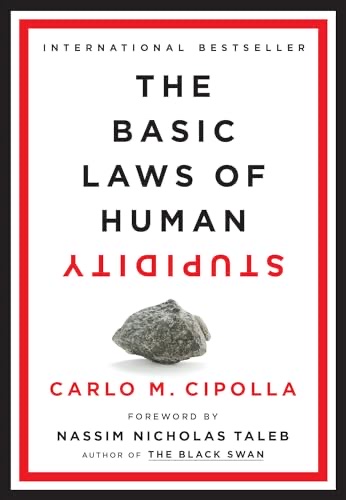
Cover of The Basic Laws of Human Stupidity

The Basic Laws of Human Stupidity

Carlo M. Cipolla

6 ideas

  1. Stupidity is independent of other traits

    Cipolla's Second Law asserts that the probability a person is stupid is independent of any other characteristic of that person. He illustrates this, tongue-in-cheek, by claiming the same fraction of stupid people appears among manual workers, white-collar employees, students, university professors and Nobel laureates.

  2. Stupid people are the most dangerous type

    Cipolla's Fifth Law holds that the stupid person is the most dangerous type, more dangerous even than the bandit. A bandit's actions follow a recognizable self-interested logic that others can anticipate. The stupid person's harm has no such rationale, so it is hard to predict or defend against.

  3. Stupidity defined by outcome, not intellect

    In Cipolla's Third Law, a stupid person is one who causes losses to another person or group while deriving no gain and possibly incurring losses themselves. The definition rests on the consequences of an action for self and others, not on intelligence, education or intent.

  4. Two-axis grid of gains and losses

    Cipolla plots any action on two axes: whether the actor gains or loses, and whether other people gain or lose. The four quadrants define the helpless (lose so others gain), the intelligent (both gain), the bandits (gain at others' expense) and the stupid (cause others loss while gaining nothing or losing themselves). The essay presents this as a satirical sorting device rather than a tested psychological model.

  5. Chronic underestimation of stupid people

    Cipolla's First Law says everyone always and inevitably underestimates the number of stupid individuals in circulation. His Fourth Law adds that non-stupid people underestimate the damaging power of stupid people and forget that dealing or associating with them tends to prove a costly mistake. Read together, the laws direct attention to the harm people fail to budget for.

  6. Societal decline and the stupid fraction

    Cipolla argues the fraction of stupid people is constant across societies, so the difference between a society that rises and one that declines lies in the rest of the population. In a declining society, bandits increasingly take on stupid traits and the helpless grow in number, which strengthens the destructive power of the stupid. This is presented as part of the essay's comic argument rather than as demonstrated historical evidence.

Save and mark ideas in the app