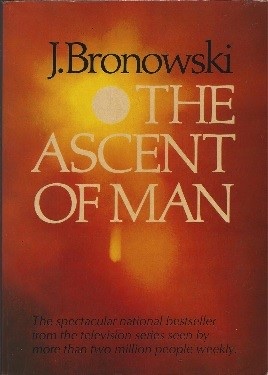
Cover of The Ascent of Man

The Ascent of Man

J. Bronowski

7 ideas

  1. Knowledge is provisional, not absolute

    All scientific knowledge carries a margin of uncertainty, and treating any theory as final, complete truth is the seed of dogma and tyranny. The pursuit of certainty in human affairs — political or scientific — leads to the gas chambers, while the acceptance of tolerance and error is what makes knowledge advance.

  2. Science as a way of seeing structure

    Scientific progress comes from finding hidden likenesses and unifying patterns beneath apparent diversity — recognizing that the falling apple and the orbiting moon obey one law. Discovery is not the accumulation of facts but the imaginative act of perceiving an underlying order that was always present but unseen.

  3. Imagination as foreseeing absent futures

    The distinctive human gift is the ability to hold images of things not present — to plan, to imagine consequences, and to act on a future that does not yet exist. This capacity to manipulate symbols and anticipate outcomes is what separates human action from animal reaction.

  4. Bronowski kneels in the Auschwitz pond

    At the end of the 'Knowledge or Certainty' episode, Bronowski stands in the pond at Auschwitz where the ashes of some four million people were flushed, including many of his own family. He scoops up the mud and says this was done not by gas but by arrogance and dogma: it is what happens when people believe they have absolute knowledge with no test in reality. He sets this against Heisenberg's uncertainty principle, which he renames the 'principle of tolerance', the recognition that all knowledge is limited and must be held with an error margin.

  5. The hand is the mind's cutting edge

    Bronowski argues that human intellect advanced through making things, not through pure contemplation. The precision grip, tool-shaping and craft skill force the brain to plan ahead, visualise outcomes and grasp how materials are structured. Science grows out of this craftsman's tacit knowledge of how things come apart and fit together.

  6. The accidental hybrid wheat that bound farmers

    Bread wheat's plump ears are too tightly bound to scatter their seed on the wind. The plant can now propagate only if humans harvest and sow it, so wheat and people became mutually dependent, and that dependency tied people to settlement and began civilisation.

  7. Humans shape the landscape rather than fit it

    Other animals are fitted to their environment by biological evolution. Humans instead change the environment and pass that capacity on through culture, which accumulates far faster than genes. Seen this way, human history is a cultural ascent: each generation starts from the knowledge and inventions of the last, rather than from the same biological baseline.

Save and mark ideas in the app