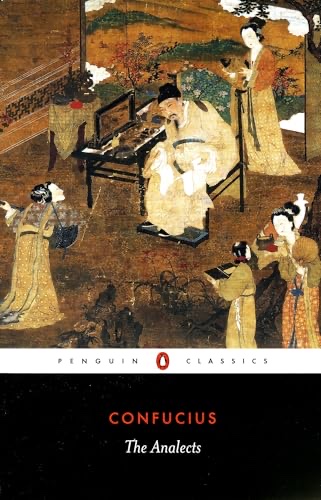
Cover of The Analects

The Analects

Confucius

17 ideas

  1. Ren as Reciprocal Human-Heartedness

    The core virtue ren operates as a relational disposition: never impose on others what you would not want imposed on yourself, and help others establish themselves as you wish to be established. It is not a feeling but a practiced orientation toward extending one's own self-regard outward to those around you.

  2. Rectification of Names

    Social order depends on language matching reality: a ruler must actually function as a ruler, a father as a father, or words become detached from roles and obligations collapse. When names are correct, expectations and duties align; when they are corrupt, punishments miss the mark and people have nowhere to place their hands and feet.

  3. Govern by Virtue, Not Punishment

    A ruler who leads through coercive law and punishment produces subjects who evade wrongdoing without shame, while a ruler who leads through moral example and ritual propriety produces subjects who develop an internal sense of shame and correct themselves. Authority radiates outward like the pole star around which others orient, requiring no force.

  4. Li as Embodied Social Choreography

    Ritual propriety (li) is the concrete set of gestures, manners, and ceremonial forms through which abstract virtue becomes visible and practiced in daily conduct. Without ritual, courage becomes unruliness and caution becomes timidity — the forms shape raw qualities into proper behavior.

  5. The Junzi as Developmental Standard

    Judge actions by the gap between the exemplary person (junzi) and the small-minded person (xiaoren): the exemplary person understands what is right while the small person understands what is profitable, and is at ease without arrogance where the small person is arrogant without ease. This is a continuum of cultivation, not a fixed caste — anyone can move along it through effort.

  6. Learning Paired With Reflection

    Study without thinking leaves one lost and disoriented, while thinking without study is dangerous and ungrounded — knowledge requires both inputs and active integration. Genuine knowing also means recognizing the boundary: to know what you know and know what you do not know is what knowing actually is.

  7. Governing by virtue outperforms governing by punishment

    If people are led by regulations and kept in line by punishments, they will avoid wrongdoing but feel no shame. If they are led by virtue and kept in line by ritual, they develop a sense of shame and correct themselves. Coercion gets compliance only while someone is watching, while example and shared norms build inner restraint that holds without enforcement.

  8. Rectification of names aligns words with reality

    Asked what he would do first if given charge of a government, Confucius said he would rectify names: make sure the ruler acts as a ruler, the father as a father, and titles match actual conduct. When words stop matching what they refer to, instructions cannot be carried out, punishments miss their mark, and people no longer know how to act. Clear public language comes before any policy.

  9. Don't impose what you wouldn't want

    Asked by Zigong for one word to practice throughout life, Confucius offered reciprocity (shu): do not impose on others what you would not want for yourself. The principle asks you to picture yourself on the receiving end before acting toward others.

  10. Same question, opposite answers for two disciples

    Zilu and Ranyou each asked whether they should act at once on what they had heard. Confucius told the rash Zilu to consult his elders first and told the hesitant Ranyou to act immediately. He explained that one needed holding back and the other needed pushing forward. His teaching adjusted to each student's temperament instead of repeating a single fixed doctrine.

  11. The gentleman is not a tool

    A tool is built for one fixed function, but the cultivated person (junzi) is not defined by a single specialized use. Their worth lies in judgment and character that apply across any role. Broad moral capacity is ranked above narrow technical skill.

  12. Reciprocity as the one-word guide

    Asked for one word to guide a whole life, Confucius offers shu, reciprocity: do not impose on others what you would not want for yourself. The test is run from the inside. You ask how the act would land on you, which turns ethics into repeated perspective-taking rather than rule lookup.

  13. An uncorrected mistake becomes a second mistake

    Making an error is not the real fault. Seeing it and failing to change is a new, separate error. Moral failure is located in how a person responds to their mistakes, so the right move is prompt correction without defensiveness.

  14. The leader's character is the wind

    The virtue of the ruler is like wind and that of the people like grass: when the wind blows over it, the grass bends. On this view, influence flows mainly from the visible conduct of those at the top, not from commands. If you want to change a population's behavior, look first at what its leaders actually model.

  15. Learning and thinking must pair

    Learning without thinking leads to confusion, and thinking without learning leads to danger. Taking in received knowledge and reflecting on it independently are both required, because each fails on its own in a different way. Real knowledge also means knowing what you know and admitting what you don't.

  16. Ritual form without inner feeling is empty

    'A person who is not humane: what has he to do with ritual?' Ritual propriety (li) gets its value from the humaneness (ren) it expresses. In mourning, sincere grief matters more than elaborate ceremony, and in ceremony, frugality matters more than extravagance. Outward form is a vehicle for inner disposition and turns hollow when detached from it.

  17. Seventy-year arc of self-cultivation

    Confucius describes his life in stages: at fifteen he set his heart on learning, at thirty he took his stand, at forty he was free of doubts, at fifty he knew heaven's mandate, at sixty his ear was attuned, and at seventy he could follow his heart's desires without overstepping the bounds. Cultivation is shown as decades of practice until right action becomes spontaneous, so that desire and propriety finally coincide.

Save and mark ideas in the app