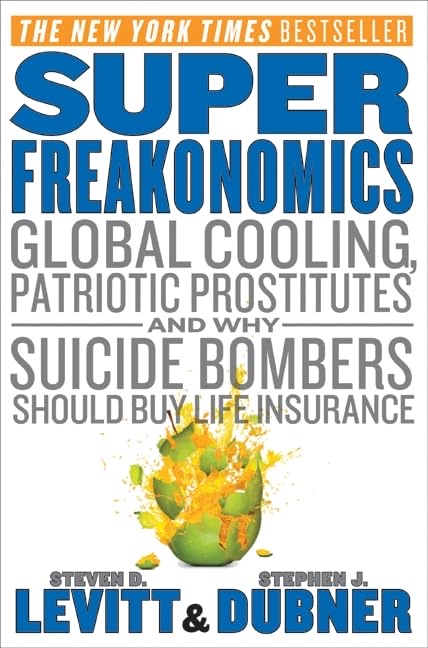
Cover of Superfreakonomics

Superfreakonomics

Levitt & Dubner

6 ideas

  1. Cheap simple fixes beat expensive complex ones

    Many large problems have surprisingly cheap, simple, unglamorous solutions that get ignored because people are drawn to dramatic, costly interventions. Cooling the planet, for example, might be achieved by pumping sulfur dioxide into the stratosphere through a hose at a tiny fraction of the cost of restructuring the global economy.

  2. People respond to incentives even unconsciously

    Behavior shifts predictably when the costs and benefits of an action change, even in moral or intimate domains people claim are immune to economics. Prostitutes adjust their prices and services to demand, and oral sex became cheaper relative to intercourse as it grew socially acceptable, showing market logic operating beneath apparent taboos.

  3. Doctors washing hands and unseen externalities

    Ignaz Semmelweis discovered that doctors carrying contagion on their hands killed mothers in childbirth, yet handwashing compliance stayed low for over a century because the cost fell on the doctor while the benefit was invisible and accrued to the patient. Even at Cedars-Sinai, compliance only rose when doctors were confronted with vivid evidence of the bacteria they carried.

  4. Apparent altruism is often situational

    Laboratory experiments suggesting humans are innately generous collapse when subjects can earn money or quietly avoid the choice, revealing that 'altruistic' behavior is heavily shaped by being watched and by experimental framing. What looks like a stable moral trait is frequently an artifact of context and observation.

  5. Find the cheap behavioral lever, not the moral appeal

    To change outcomes, identify the small structural change that alters incentives rather than urging people to be better. A captured car seat, a child-safety latch, or a financial penalty often outperforms education campaigns because it changes the choice architecture instead of relying on willpower or virtue.

  6. Detecting rare bad actors via data signatures

    Hidden malicious behavior can be caught by mining the statistical footprint it leaves rather than profiling individuals directly. Would-be terrorists, for instance, can be flagged by combinations of banking patterns—such as buying no life insurance and making sudden large deposits—because such anomalies cluster in ways innocent customers' behavior does not.

Save and mark ideas in the app