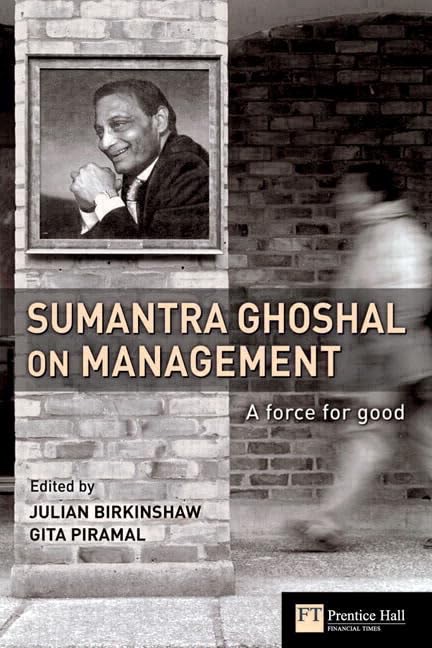
Cover of Sumantra Ghoshal on Management

Sumantra Ghoshal on Management

Sumantra Ghoshal / Gita Piramal

6 ideas

  1. Smell of the Place Shapes Behavior

    Organizations create an internal atmosphere that determines whether people operate from constraint or aspiration; most large companies feel like 'downtown Calcutta in summer' — oppressive, draining, full of compliance and fatigue. Managers must engineer a 'smell of spring' through stretch, discipline, trust, and support, because the context an employee breathes daily explains more about their performance than their individual character.

  2. Stretch, Discipline, Trust, Support Quadrant

    A revitalized organizational context is built by balancing two pairs: stretch and discipline create energy and demand, while trust and support create safety and resources. Companies that emphasize only discipline and support produce compliance, whereas adding stretch and trust converts the same people into self-driven contributors.

  3. From Strategy-Structure to Purpose-Process-People

    The old managerial doctrine of 'strategy, structure, systems' treats employees as replaceable parts to be controlled and is obsolete in a knowledge economy. Companies should instead be built on 'purpose, process, and people' — replacing the company-as-machine with the company as an institution that engages human ambition and capability.

  4. Individualized Corporation

    Value is increasingly created by individuals applying specialized knowledge, so the firm must invert the traditional relationship and organize itself around the unique capabilities of each person rather than forcing people into standardized roles. The company's job becomes attracting, developing, and unleashing scarce human talent rather than allocating capital.

  5. Managers as Institution Builders Not Allocators

    Viewing the manager's primary role as resource allocation and control misses what actually drives modern firms; the real task is building social capital, embedding shared purpose, and shaping the behavioral context. Seen this way, the manager's leverage lies in changing the system people act within, not in directing the people themselves.

  6. Faith in People Over Control Systems

    Excessive control systems signal distrust and produce exactly the low-initiative, compliance-driven behavior they are designed to police. A philosophy that begins from a positive belief in employees' desire to contribute releases discretionary effort that no monitoring apparatus can extract.

Save and mark ideas in the app