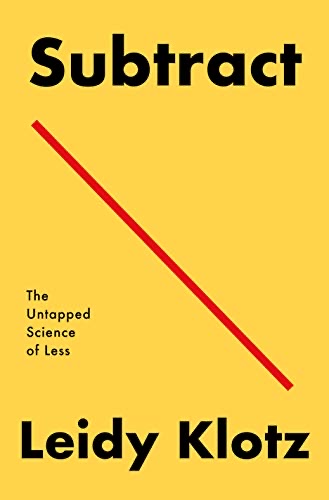
Cover of Subtract: The Untapped Science of Less

Subtract: The Untapped Science of Less

Leidy Klotz

6 ideas

  1. Subtraction Is Systematically Overlooked by Default

    When solving problems, people overwhelmingly add components, rules, or features rather than removing them, even when subtraction would produce a better result. This isn't because adding is objectively superior — it's that subtractive options rarely enter consideration at all.

  2. The Lego Bridge Stabilization Experiment

    Participants asked to stabilize a Lego structure overwhelmingly added blocks for support rather than removing the single block causing the imbalance, even though removal was simpler and was the intended fix. The bias persisted even when removing a block had no cost and adding one did, revealing that subtraction simply doesn't get searched for.

  3. Add-By-Default Mental Search

    The mind generates candidate solutions by transforming a situation, and transformation is mentally encoded as addition before subtraction is ever considered. Subtraction requires a deliberate second cognitive step, so under time pressure or cognitive load, additive solutions win simply by arriving first.

  4. Subtraction Leaves No Visible Trace

    Added things are countable and demonstrable, while what was removed becomes invisible once gone, making subtractive work hard to notice or credit. This invisibility means people who improve things by removing get less recognition than those who add, reinforcing the additive instinct socially as well as cognitively.

  5. Make Subtraction an Explicit Option

    Because subtraction won't surface on its own, you must deliberately prompt for it — asking 'what can we remove?' as a distinct step rather than only 'what can we add?'. Building subtraction into checklists, reviews, and design processes counters the default rather than relying on individual willpower to remember it.

  6. Less As Active Achievement, Not Absence

    Subtracting should be seen as a positive act of improvement requiring skill and judgment, not as failure to add or as mere reduction. Reframing 'less' as something you build toward — better through removal — changes which solutions feel competent and worthy of effort.

Save and mark ideas in the app