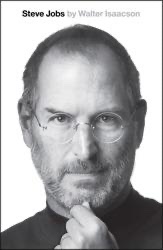
Cover of Steve Jobs

Steve Jobs

Walter Isaacson

7 ideas

  1. Design Is How It Works

    Aesthetics are not surface decoration applied after engineering; the look, feel, and behavior of a product are inseparable from its function and must be designed together from the start. This is why obsessing over invisible internals — the circuit boards, the unseen screws — is treated as morally equivalent to obsessing over the visible exterior.

  2. Binary Judgment Forces Decisions

    Sorting everything and everyone into 'the best' or 'shit' with no middle ground compresses ambiguity into action, eliminating the paralysis of nuance. The cost is volatility and unfairness, but the benefit is a relentless filter that strips away mediocrity by refusing to tolerate it.

  3. Walking Away From The Cancer Surgery

    After diagnosis, Jobs delayed conventional surgery for nine months to pursue diet, acupuncture, and alternative remedies, believing he could control his body the way he controlled products. The same will that bent engineers to impossible goals proved useless against biology, and the delay likely cost him his life.

  4. End-to-end control of the whole product

    Jobs insisted that one company control hardware, software and content together, and later the retail stores too. His view was that a seamless user experience cannot be built out of parts other people make. The cost was a closed system that lost market share early to open licensing, as the Mac did to Windows. It paid off once integrated devices like the iPod-iTunes pairing and the iPhone made simplicity worth more than openness.

  5. Return to Apple and product-line cut

    When Jobs came back in 1997, Apple was weeks from insolvency and sold a sprawling range of Macintosh variants. He drew a two-by-two grid (consumer/pro, desktop/portable) and cut the line to four products. Then he killed the Newton and the Mac clone licences. Focusing on the iMac and then the iPod turned Apple from near-bankruptcy into the world's most valuable company within about fourteen years.

  6. Taste at the intersection of disciplines

    Jobs' advantage came from standing where the humanities meet technology. He brought design sensibility, from calligraphy to Bauhaus to minimalism, into engineering choices. This meant hidden parts like circuit-board layout had to be beautiful too, and features were ruthlessly removed for simplicity. Isaacson argues this taste, joined to a brutal binary judgment of work as either brilliant or 'shit', is what set Apple's products apart. It also made the culture abrasive.

  7. Reality distortion field as persuasive tool

    Jobs used total conviction, charm and a refusal to accept facts that stood in his way. This got colleagues to commit to deadlines and technical goals they believed were impossible, and they sometimes met them because they had stopped treating the limit as fixed. The same mechanism turned harmful when he aimed it at things that could not be bent, such as delaying surgery for his pancreatic cancer.

Save and mark ideas in the app