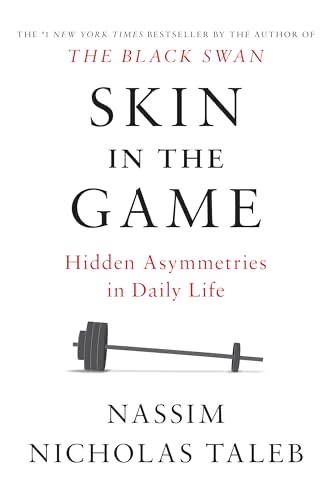
Cover of Skin in the Game

Skin in the Game

Nassim Nicholas Taleb

7 ideas

  1. Skin in the Game as Filter

    Those who make decisions must bear a proportional share of the harm if those decisions go wrong; this symmetry filters out bad risk-takers over time because they are eventually destroyed by their own exposure. Without downside exposure, agents can transfer hidden risks to others while keeping the upside for themselves.

  2. The Lindy Effect for Durability

    For non-perishable things like ideas, books, and technologies, future life expectancy is proportional to current age: every additional year of survival predicts a longer remaining lifespan. This makes time the only unbiased test of what is fragile versus robust, since fads die young and what has lasted has already passed countless hidden stress tests.

  3. Minority rule of the intransigent few

    A small, inflexible minority can impose its preference on a whole population when the flexible majority finds it cheaper to comply than to split. Examples are kosher or halal labels and peanut-free foods. Because the rigid group will not accept the alternative and the majority is indifferent, the minority's rule becomes the default everywhere.

  4. Trust those who pay for error

    To judge someone's advice, ask what happens to them if they are wrong, not how credentialed or eloquent they are. Advisers who lose nothing when their forecasts fail have no filter against nonsense. People with exposure to consequences are stripped of error by reality over time.

  5. Ergodicity: ruin makes averages misleading

    The average outcome across many people is not the same as the outcome one person gets repeating a risk over time. Any exposure to ruin, a loss you cannot recover from, makes the group expected value irrelevant, because one wipeout ends all future play. Surviving is therefore the precondition for every other goal, and repeated small risks of ruin must be avoided outright.

  6. Hammurabi's builder who dies with occupants

    Hammurabi's code decreed that if a house collapses and kills its owner, the builder shall be put to death. Builders know best where to hide structural flaws that won't show until long after payment. The law aligned the builder's fate with the building's soundness, turning hidden risk into personal exposure.

  7. Intellectual Yet Idiot class

    The Intellectual Yet Idiot is an educated, credentialed class that shapes policy and opinion while being insulated from the practical results of its prescriptions. It mistakes theoretical knowledge for understanding of messy reality. Because it is rarely penalized when its interventions fail, its errors accumulate rather than being corrected.

Save and mark ideas in the app