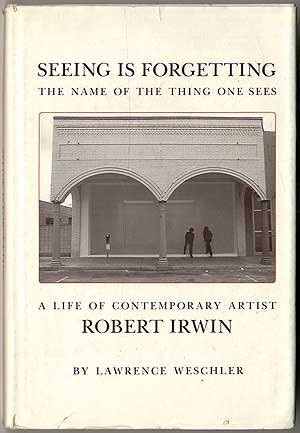
Cover of Seeing is Forgetting the Name of the Thing One Sees

Seeing is Forgetting the Name of the Thing One Sees

Lawrence Weschler, Robert Irwin

7 ideas

  1. Irwin Abandons The Object

    The artist progressively stripped his work down — from gestural paintings to nearly blank discs to pure environments of scrimmed light — eventually leaving the studio and gallery entirely to work with conditioned perception in real space. The trajectory shows an artist following a single question so relentlessly that it dissolves the medium he started with.

  2. Art Is Conditioned Perception, Not Object

    The value of an artwork lies not in the physical object but in the heightened state of attention it provokes in the viewer — the art is the act of perceiving made conscious. This means the same physical setting can be art or not art depending entirely on the quality of attention brought to it.

  3. Questions As The Engine Of Inquiry

    Productive work proceeds by treating each answer as the source of the next question rather than as a conclusion, so that the inquiry keeps refining itself indefinitely. The discipline is to keep asking 'what is this really about?' and following the question even when it forces you to abandon your current tools and assumptions.

  4. Naming a thing replaces actually seeing it

    Once we recognize and name an object, perception stops and the concept stands in for the sensory encounter, so we see our label rather than what is present. Real seeing means suspending the name long enough to register the raw qualities of light, edge, texture, and presence that recognition normally filters out.

  5. The frame generates meaning before content does

    Any mark placed inside a bounded rectangle automatically becomes a figure against a ground and gets read as an image, so the edge itself imposes representation regardless of the artist's intent. To make a work about perception rather than depiction, the artist must dissolve the frame and edge until the viewer can no longer tell where the object stops and the surrounding world begins.

  6. Four degrees of site responsiveness

    Public art can be sorted by how much the place shapes the work: site-dominant pieces are portable monuments that ignore their location; site-adjusted pieces are scaled or placed to fit it; site-specific pieces are conceived with the location in mind but still come from the artist's existing vocabulary. Site-conditioned, or site-determined, work begins only after sustained attention to a place's light, use, history, and feel, and draws its form entirely out of those conditions.

  7. Irwin paints his way out of painting

    Next came convex aluminum and acrylic discs lit so their shadows made the object's boundary dissolve into the wall. Around 1970 he closed his studio, stopped producing objects, and began working directly with light, space, and the conditions of particular places.

Save and mark ideas in the app