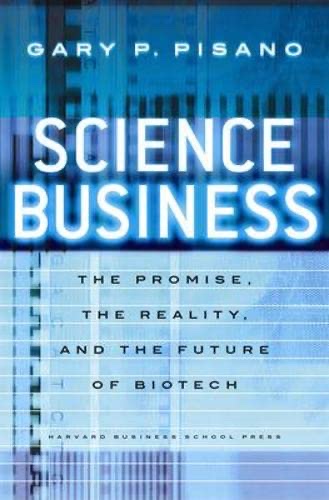
Cover of Science business

Science business

Gary P. Pisano

6 ideas

  1. Biotech has not delivered its promised returns

    Pisano shows that despite decades of scientific breakthroughs, the biotech sector as a whole has produced modest, uneven profits and few sustainably profitable firms. The gap between science and business performance is the book's central puzzle.

  2. Anatomy of an industry: the three failures

    Pisano argues biotech's business model mismatches its science on three counts: profound and persistent uncertainty, knowledge spread across many disciplines that must be integrated, and cumulative learning that the market structure disrupts. The Silicon Valley venture model was imported without fixing these.

  3. Integration versus the market-for-ideas model

    The dominant model splits drug discovery across specialized firms trading intellectual property, but Pisano contends drug R&D requires integrated organizations that hold and accumulate knowledge over long horizons. Fragmentation defeats the cumulative learning that hard problems demand.

  4. Monetizing science needs the right institutions

    Pisano generalizes from biotech to argue that turning any new science into a business requires an institutional architecture matched to the science's uncertainty and learning needs. Copying the model from another industry, like software, systematically misfires.

  5. Anomalies and long horizons defeat capital markets

    Because drug development spans a decade or more with high failure rates, public and venture capital markets that reward short-term signals price and manage biotech poorly. The financing structure fights the biology.

  6. Science-based business as a distinct type

    Pisano defines a category of firm whose competitive advantage rests on advancing fundamental science, not just applying it. Such firms need governance, financing and organization built for open-ended discovery rather than predictable engineering.

Save and mark ideas in the app