The Cognitive Revolution
Around 70,000 years ago Homo sapiens developed the ability to imagine and share fictions through language. This enabled flexible cooperation among large numbers of strangers, the trait that set the species apart.
7 ideas
Around 70,000 years ago Homo sapiens developed the ability to imagine and share fictions through language. This enabled flexible cooperation among large numbers of strangers, the trait that set the species apart.
Social hierarchies and laws persist because enough people accept the shared story behind them, not because they are objectively grounded. Once belief collapses, the imagined order collapses with it.
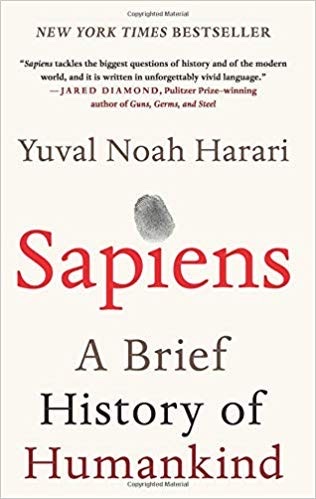
Harari reads all of human history through biology, anthropology, and economics as a sequence of revolutions. The wide-angle view treats culture as the product of a few pivotal cognitive and material shifts.
Farming raised the total amount of food available, but that surplus turned into population growth and elites rather than better lives for individuals. The average farmer worked harder, ate a narrower and less nutritious diet, and faced more disease and famine than the forager. Wheat, in effect, domesticated humans. Each small step toward agriculture seemed rational at the time, but these steps added up to a trap that could not be reversed once populations depended on it.
Premodern knowledge traditions assumed that everything important was already known, whether to scripture or to the ancients. Modern science began when Europeans admitted collective ignorance, which the blank spaces on maps after America's discovery made visible. Admitting ignorance, together with empiricism, mathematics and investment from empires and capital, created a feedback loop: belief in future growth justified credit, and credit funded the research that produced the growth.
Harari uses the French carmaker Peugeot, whose lion logo appears on its cars, to ask where the company actually exists. If all its factories were destroyed and all its workers were fired, Peugeot would still exist, and it could borrow money and rebuild. If a court ordered it dissolved, it would vanish even with every factory still standing. The company exists only as a 'limited liability' legal fiction that lawyers bring into being, much as priests invoke gods through ritual.
Humans can cooperate flexibly with strangers because they share beliefs in intersubjective realities such as gods, nations, money, corporations and human rights, which exist only in collective imagination. Once a group numbers more than about 150, gossip and personal acquaintance can no longer hold it together; a common story believed by all lets millions coordinate without knowing each other. Because these orders are imagined, they can be rewritten, which lets sapiens change social behaviour faster than genetic evolution allows.