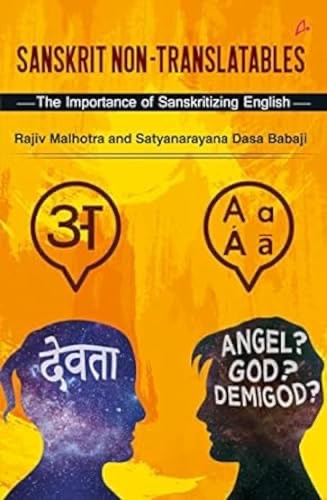
Cover of Sanskrit Non-Translatables

Sanskrit Non-Translatables

Rajiv Malhotra, Satyanarayana Dasa Babaji

6 ideas

  1. Some Sanskrit words cannot be translated

    Malhotra argues that terms like dharma, atman, and shakti lose or distort meaning when mapped to English words like religion or soul. Forcing them into Western categories, he says, digests and dilutes Indic thought.

  2. Sanskritization of English

    He proposes adopting Sanskrit terms directly into English, as words like karma and yoga already have. Preserving the original word protects the concept's full meaning.

  3. Translation as cultural power

    The book frames the translation of sacred vocabulary as an act of intellectual colonization. Who defines the words, Malhotra argues, controls how a tradition is understood.

  4. A lexicon of non-translatables

    With Satyanarayana Dasa, the book catalogs specific Sanskrit terms and explains why each resists English equivalence. The entries function as a defense manual for Indic concepts.

  5. Mapping distorts, not just simplifies

    He contends that equating atman with soul imports Abrahamic assumptions foreign to Vedanta. The error is not incompleteness but active misrepresentation.

  6. Language as carrier of worldview

    Malhotra treats vocabulary as inseparable from the metaphysics it encodes. To keep the worldview intact, one must keep the words intact.

Save and mark ideas in the app