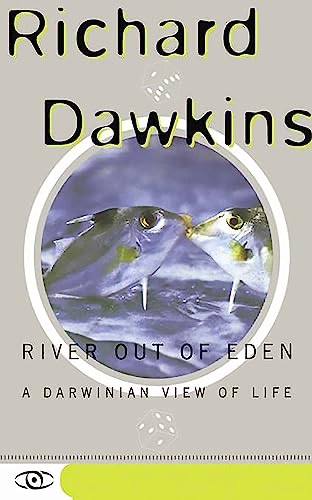
Cover of River Out of Eden

River Out of Eden

Richard Dawkins

8 ideas

  1. All Life Descends From One Ancestor

    Every organism alive shares an unbroken line of ancestors stretching back to a single original population, none of which died before reproducing. This means each living thing carries genes that have an uninterrupted record of reproductive success going back billions of years.

  2. The Wasteful Honeybee Death Dance

    Worker bees communicate the direction and distance of food through a precise waggle dance, demonstrating sophisticated optimization in nature. Yet the same gene-driven 'utility function' produces grotesque waste and suffering, like parasitic wasps eating prey alive from within, showing optimization serves gene replication and not the welfare of any creature.

  3. Evolution as a branching river of genes

    Dawkins recasts life as a digital river of DNA flowing through geological time, with individual bodies as temporary vehicles the genes pass through. Speciation is a split in the river: once two branches stop exchanging genes through sex, they diverge independently. On this view the real continuity in biology is the coded information, not the organisms carrying it.

  4. Everyone descends from unbroken successful ancestors

    Dawkins points out that each of your ancestors survived to adulthood and reproduced, while many of their contemporaries did not. Genes are therefore inherited from a lineage filtered for whatever helped bodies survive and reproduce in their environments. He uses this to explain why organisms appear well built for survival without anyone designing them.

  5. Mitochondrial Eve and single-line ancestry

    Because mitochondrial DNA passes only through the maternal line, it can be traced back to a single woman who is the most recent maternal-line common ancestor of all living humans. The evidence points to an African location for her, though Dawkins treats her date and place as tentative estimates. He stresses that she was one of many ancestors alive at the time, not the sole mother of humanity.

  6. Reverse engineering nature's utility function

    To understand an organism, Dawkins suggests treating it as an engineer would a device, asking what quantity its design appears to maximize. His answer is that living things are built to maximize the survival of the DNA that codes for them, not the good of the species or the individual's happiness. Features such as sex ratios, or the arms race between predator and prey, make sense when read through this function.

  7. Complex eyes can evolve through small steps

    Dawkins argues that a partial eye is useful because a little vision is better than none, so every intermediate stage can be favoured by selection. He cites Nilsson and Pelger's model, in which a flat light-sensitive patch becomes a camera-type eye in under about 400,000 generations under deliberately pessimistic assumptions. On geological timescales that is brief, which undercuts the objection that such organs are too complex to evolve.

  8. Nature shows blind, pitiless indifference

    Dawkins argues that the suffering in nature, such as prey eaten alive or parasites consuming hosts, follows directly from DNA replication and has no moral purpose. The universe looks as it would if it had no design, purpose, good or evil, only indifference. He contends that expecting nature to be either kind or cruel misreads a process that has no concern for welfare.

Save and mark ideas in the app