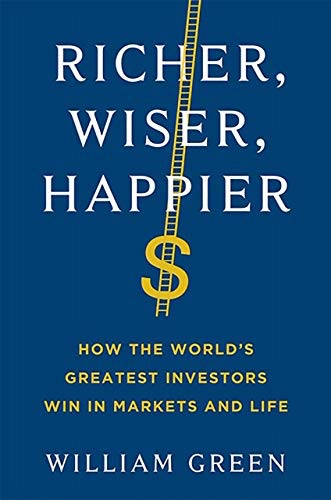
Cover of Richer, Wiser, Happier

Richer, Wiser, Happier

William Green

10 ideas

  1. Build a Margin of Safety

    Always buy assets for substantially less than their intrinsic worth, so that even if your analysis is wrong or the future disappoints, the gap between price and value absorbs the error. The discount is not just a profit cushion but a defense against the inherent unpredictability of outcomes.

  2. Temperament Beats Intelligence in Investing

    Long-term investment success depends less on raw IQ than on emotional discipline — the ability to stay rational when others panic, resist herd behavior, and act decisively only when the odds are strongly in your favor. The market rewards those who can control fear and greed more than those who are merely clever.

  3. Inverting to Avoid Stupidity

    Rather than only asking how to succeed, systematically ask what would cause failure and then avoid those things — survival and the elimination of catastrophic errors compound into success over time. Consistently not being stupid beats trying to be brilliant.

  4. Markets Are Cyclical, Not Linear

    Prices and sentiment swing between extremes of euphoria and despair, so conditions that feel permanent are usually temporary and self-reversing. Viewing markets through this pendulum lens lets you lean against the prevailing mood — buying when others are fearful and trimming when others are euphoric.

  5. Concentrate on a Few High-Conviction Bets

    Because genuinely great opportunities are rare, the disciplined investor waits patiently for them and then invests heavily when one appears, rather than diluting returns across many mediocre ideas. Wide diversification protects the ignorant; concentration rewards those who know a few things deeply.

  6. Scale Economics Shared with Customers

    Some companies pass their cost savings from growing scale back to customers as lower prices instead of keeping them as margin. Costco and Amazon are the book's examples. Lower prices attract more volume, which lowers costs further and repeats the cycle, building a moat that competitors chasing short-term profit cannot match.

  7. Strategies Endure Because They Periodically Fail

    Joel Greenblatt argues that a sound investing method keeps working only because it underperforms for painful stretches, sometimes years. Those stretches drive impatient investors to abandon it, and their exit keeps the opportunity from being arbitraged away. The edge therefore belongs to people who can tolerate looking wrong, not to people who have the formula.

  8. Shameless Cloning of Proven Ideas

    Mohnish Pabrai deliberately copies the best ideas and investments of superior investors, above all Warren Buffett, instead of prizing originality. He pairs this with a low-risk, high-uncertainty bet structure: 'heads I win, tails I don't lose much.' Ego-free borrowing of tested methods beats trying to invent something new, and most people fail to clone because pride makes copying feel beneath them.

  9. Nick Sleep's Nomad Partnership and Patience

    They concentrated capital in a few companies such as Amazon, Costco and Berkshire Hathaway, then held them for years while ignoring short-term noise, reportedly returning about 921 percent against roughly 117 percent for the MSCI World index. They closed the fund and returned outside money while still performing well, and kept managing their own wealth the same way. The case shows that inactivity and long holding periods can be the source of an edge, not a lack of effort.

  10. Designing Your Environment Over Willpower

    Guy Spier limits his own irrational behavior by changing his surroundings instead of relying on self-control. He moved from Manhattan to Zurich to escape the noise of Wall Street. He also sets rules such as not checking stock prices constantly and not talking to company management in ways that bias him. The premise is that intelligence cannot overcome a distorting environment, so the environment must be changed deliberately.

Save and mark ideas in the app