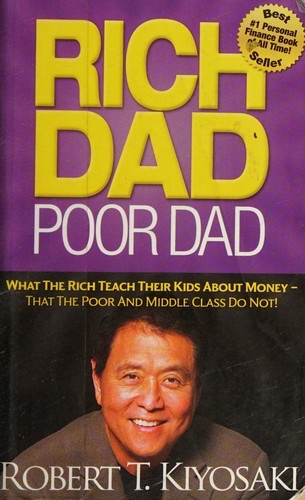
Cover of Rich Dad Poor Dad

Rich Dad Poor Dad

Robert T. Kiyosaki

13 ideas

  1. Assets Feed You, Liabilities Eat You

    An asset is anything that puts money into your pocket whether you work or not; a liability is anything that takes money out. The rich accumulate income-generating assets first and buy luxuries with the cash those assets throw off, while the middle class buys liabilities they mistake for assets — like a personal home — and funds them with labor income.

  2. Work To Learn, Not To Earn

    Choosing jobs for the skills they teach — sales, marketing, communication, systems-building — compounds into wealth far more than chasing the highest salary. Specialists trapped in narrow expertise stay dependent on employers, while generalists who deliberately acquire money-making skills can build their own income engines.

  3. Pay Yourself First Under Pressure

    Allocate money to your own investments before paying creditors and bills, deliberately creating financial pressure that forces you to generate additional income rather than dipping into the investment. The discipline works because the fear of not paying others becomes a motivator to earn more, instead of the savings being the first thing sacrificed.

  4. Salaried security as a fear-driven trap

    The book frames a steady job as a mechanism by which fear of not paying bills and desire for more consumption keep people working for others, taxed first, and never accumulating assets. Through this lens, pay raises only fund larger liabilities, and the escape is to 'work to learn, not to earn' and move toward business ownership and investing.

  5. Income statement versus balance sheet flows

    The book diagrams three cash-flow patterns: the poor spend all income on expenses, the middle class route income into liabilities such as mortgages and car loans, and the rich route income into assets whose returns then cover expenses. Wealth is measured by whether passive asset income exceeds monthly expenses, the point at which one is said to escape the rat race.

  6. Leverage turns small capital into wealth

    Kiyosaki advocates using borrowed money and creative financing to buy real estate and businesses so that other people's money funds assets whose cash flow and appreciation accrue to the owner. The mechanism depends on asset income exceeding debt service and on credit remaining available.

  7. Two fathers with opposite money scripts

    The narrative contrasts the author's highly educated, salaried biological father, who says 'I can't afford it' and ends in financial difficulty, with a mentor, the rich dad, who asks 'How can I afford it?' and builds businesses. The pairing makes mindset and vocabulary look like the causal driver of wealth.

  8. Your house is not an asset

    Kiyosaki argues that an owner-occupied home is a liability because mortgage payments, taxes, insurance and maintenance drain cash monthly while producing no income. He treats buying a larger home as the classic middle-class trap that locks up capital which could otherwise have bought income-producing property.

  9. Assets put money in your pocket

    Kiyosaki redefines an asset as anything that puts money into your pocket and a liability as anything that takes money out, regardless of what an accountant's balance sheet says. Under this definition a home you live in is a liability because it drains mortgage, tax and maintenance cash. The redefinition moves attention from net worth to monthly cash flow.

  10. Cashflow Quadrant of income sources

    Income earners are sorted into four quadrants: Employee and Self-employed on the left, Business owner and Investor on the right. Left-side people trade their own time for money. Right-side people earn from systems and capital that work without their presence, and the framework claims that lasting wealth and tax advantages sit on the right.

  11. Salaried poor dad versus entrepreneurial rich dad

    The narrator contrasts his educated, salaried father, who valued job security and said 'I can't afford it', with his friend's entrepreneur father, who asked 'How can I afford it?' The two dads stand for opposing money scripts passed from parent to child. The parable teaches that financial outcomes follow inherited attitudes more than income or formal education.

  12. The rat race of rising expenses

    The rat race is the loop in which each raise is absorbed by bigger spending, larger debts and higher taxes, so the earner must keep working to cover a lifestyle that grows with income. The way out is to direct surplus income into income-producing assets until passive income exceeds expenses. The book's board game models this exit condition directly.

  13. Schools deliberately omit financial literacy

    Kiyosaki argues that formal schooling trains people to be employees and never teaches reading financial statements, taxes or investing. He claims this gap, rather than low pay, keeps the poor and middle class from building wealth.

Save and mark ideas in the app