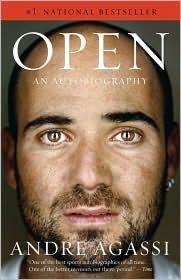
Cover of Open: An Autobiography

Open: An Autobiography

Andre Agassi

12 ideas

  1. Hating Your Craft While Excelling At It

    Sustained elite performance does not require loving the activity; it can coexist with deep hatred for it, sustained instead by external pressure, identity entanglement, and the absence of perceived alternatives. The skill grows mechanically through forced repetition even as the emotional relationship with the work corrodes.

  2. Contradiction As Stable Self-State

    A person can hold two genuinely opposed truths simultaneously — being the best at something and despising it — without resolving the tension, and this contradiction becomes the operating baseline rather than a problem to fix. Identity is not internally consistent; it functions while fractured.

  3. The Ball Machine As Childhood Adversary

    A father builds a machine that fires tennis balls at a child for thousands of repetitions daily, treating volume of strokes as the sole input to mastery. The child internalizes the machine as an enemy that must be defeated, turning training itself into an antagonist rather than a path.

  4. Image As Imposed Rather Than Chosen

    Public persona is frequently constructed by handlers, sponsors, and audiences and then mistaken by everyone — including the person — for authentic identity, so the gap between the marketed self and the actual self becomes a private burden. Viewing fame this way reveals 'selling out' as often a thing done to someone before they consent to it.

  5. He hated the game he mastered

    Agassi opens by declaring he despised tennis with a dark and secret passion, a sport chosen for him by a driving father. The memoir's engine is the gap between world-class performance and inner revulsion.

  6. The ball machine named 'the dragon'

    His father built a homemade ball machine that fired thousands of balls daily, drilling Agassi from childhood. The image captures how mastery was imposed, not chosen, shaping his ambivalence.

  7. The image is nothing, the self is everything

    Agassi traces his arc from marketed rebel ('image is everything') to a player who rebuilds around meaning rather than persona. Reinvention, including hitting rock bottom and climbing back to number one, is the throughline.

  8. Elite performance runs on relationships

    His comeback is powered by a small circle, trainer Gil Reyes, coach Brad Gilbert, that supplies structure and belief. The book reframes individual sport as sustained by a chosen team.

  9. The Dragon and the Million-Ball Arithmetic

    As a boy in Las Vegas, Agassi was drilled daily by his father, Mike, against a souped-up ball machine he called 'the dragon'. Mike's logic was pure volume: 2,500 balls a day meant 17,500 a week and nearly a million a year, and he said a child who hits a million balls a year will be unbeatable. The regime worked, and it produced a world-class player who says he hated the game from the start, which makes it a test case for whether sheer repetition imposed from outside can build mastery without building love.

  10. Crystal Meth, a Lie, and the Comeback

    In 1997, depressed and in a failing marriage, Agassi used crystal meth, failed an ATP drug test, and wrote a letter falsely claiming he had unknowingly drunk a spiked soda; the ATP accepted the excuse. His ranking fell to 141, and he rebuilt by playing low-tier Challenger events. In 1999 he won the French Open, completing the career Grand Slam, and reached world number one. The comeback began only once he chose tennis for himself, rather than playing because he was told to.

  11. Excellence and Hatred Can Coexist Indefinitely

    Being elite at something you never chose does not produce love for it. It can produce a deep hatred that runs alongside world-class performance for decades. Agassi's sense of self was built by his father and not by himself, so winning brought relief instead of joy and losing felt like annihilation. Meaning arrived only when he attached the work to a purpose of his own, a charter school for poor children in Las Vegas.

  12. Play the Opponent, Not Perfection

    Coach Brad Gilbert told Agassi his perfectionism was self-defeating: by trying to hit a winner on every ball, he was beating himself. Gilbert's alternative was to study the opponent's weaknesses, keep the ball in play, and let the other player make the errors. This shifts the standard from 'play flawlessly' to 'be better than this person today', which lowers the internal pressure and wins more matches.

Save and mark ideas in the app