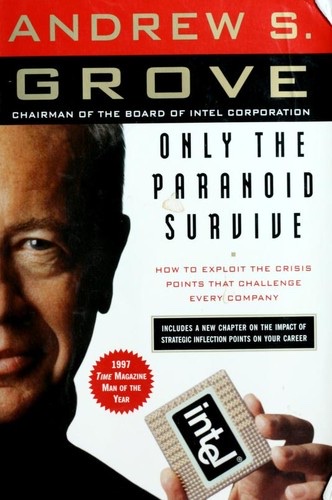
Cover of Only the Paranoid Survive

Only the Paranoid Survive

Andrew S. Grove

9 ideas

  1. Strategic Inflection Point

    A strategic inflection point is when the balance of forces shifts from the old structure of a business to a new one, where the change is so fundamental that a business's ascent or decline is determined by how it responds. It is a transition where 'the old strategic picture dissolves and gives way to the new' — and unlike a normal change, the way you do business is permanently altered.

  2. 10X Force Change Detection

    Assess any of the six competitive forces (competitors, suppliers, customers, potential competitors, substitutes, complementors) for whether one has grown to roughly ten times its prior magnitude. When a force becomes '10X,' it signals a structural shift requiring a fundamentally different strategy rather than incremental adjustment.

  3. The Valley of Death

    When traversing an inflection point, an organization must cross a chaotic transition period where the old strategy no longer works and the new one isn't yet proven. Leaders must form a clear mental image of what the company should look like on the far side and communicate that destination relentlessly to pull the organization through the disorienting middle.

  4. Productive Strategic Dissonance

    The gap between what a company says (its stated strategy) and what it actually does (where resources and energy flow) is an early warning signal of an inflection point. Rather than suppressing this contradiction, leaders should let debate between 'Cassandras' and established management surface the tension, because the friction reveals where reality has outrun official strategy.

  5. Intel exits memory for microprocessors

    In the mid-1980s, Japanese memory manufacturers undercut Intel on quality and price, and Intel's core memory business collapsed. Grove asked Gordon Moore what a new CEO brought in from outside would do. Moore answered that he would get out of memories, which led to Grove's line: "Why shouldn't you and I walk out the door, come back in, and do it ourselves?" Intel abandoned the product it was founded on and bet the company on microprocessors.

  6. Traverse the valley of death decisively

    Moving through a strategic inflection point means crossing a "valley of death." Leaders must first let chaos reign through open debate and experimentation, then rein in chaos by committing hard to a single new direction. Companies usually fail by moving too late, because they wait for certainty that arrives only after the chance to act has passed. Grove's advice is to concentrate resources on the new direction rather than hedge across options.

  7. Silver bullet test for true competitors

    To judge whether a change is real signal or noise, ask: if you had one silver bullet, which competitor would you shoot? If the answer shifts from your long-time rival to a new or unexpected player, the competitive landscape may be undergoing a 10x change. A similar test applies to people: check whether your key people seem to have lost their bearings, or suddenly seem to matter less.

  8. Middle managers move before executives admit

    Intel's middle managers, working from production and customer data, had already shifted wafer capacity from memory to microprocessors before senior leadership formally decided to leave memories. Strategic change often emerges bottom-up through resource allocation decisions, while top management's stated strategy lags behind because it is tied to identity and past success.

  9. Listen to the Cassandras on the periphery

    The first people to sense a strategic inflection point are usually those far from headquarters, such as salespeople, field engineers, and managers who face customers and competitors every day. They absorb change directly, while executives are insulated by filtered reports. Leaders should seek out these dissenting voices and weigh them before trusting their own view from the center.

Save and mark ideas in the app