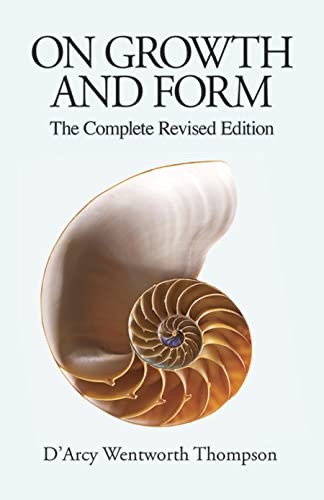
Cover of On growth and form

On growth and form

Thompson, D'Arcy Wentworth

6 ideas

  1. Physical law, not only selection, shapes form

    Thompson argues biological forms are constrained and generated by physical forces such as surface tension, gravity, and diffusion. Natural selection acts within limits that physics and geometry already impose.

  2. The theory of transformations

    He shows the shape of one species can be mapped onto a related one by a smooth deformation of a coordinate grid. Related forms are geometric variations on a shared underlying scheme.

  3. Scale governs shape

    As organisms grow, the balance of forces acting on them changes, so form cannot simply scale up proportionally. Surface-to-volume relations dictate why large and small creatures are built differently.

  4. Recurring mathematical patterns in life

    Spirals, hexagons, and logarithmic growth appear across shells, horns, and cells as expressions of simple rules. The same mathematics recurs because the same physical constraints do.

  5. Organism as a diagram of forces

    Thompson treats a living form as the visible record of the forces that produced it, readable like an engineering diagram. Form is frozen process, not arbitrary design.

  6. Mathematics as the language of biology

    He insists that describing life quantitatively reveals order that qualitative description misses. The book is a plea to bring physics-style rigor into the study of living things.

Save and mark ideas in the app