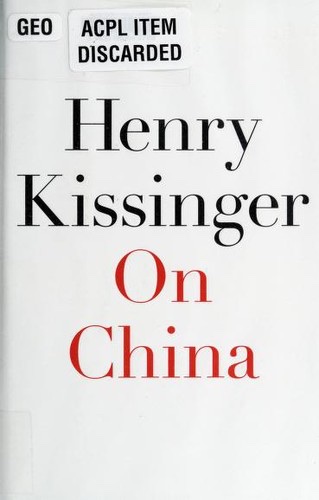
Cover of On China

On China

Henry Kissinger

6 ideas

  1. Wei Qi Versus Chess Strategic Mindset

    Chinese strategy resembles the game of wei qi (go), which builds influence gradually through encirclement and relative positional advantage across the whole board, rather than chess, which seeks decisive checkmate and total victory. This produces a strategy of accumulating small advantages and patience over time instead of pursuing a single climactic confrontation.

  2. Middle Kingdom Civilizational Centrality

    China historically saw itself not as one nation among equals but as the center of civilization, with surrounding peoples ranked by their proximity to and adoption of Chinese culture. Foreign relations were therefore managed as gradations of tributary deference rather than as diplomacy between sovereign equals.

  3. Combative Coexistence Through Calculated Risk

    Chinese statecraft can deliberately initiate a sharp, limited military or political shock against a stronger opponent to reset psychological terms and reestablish deterrence, then immediately return to coexistence. The action is calibrated to alter the adversary's calculus, not to seize territory or achieve total defeat.

  4. Mao's 1958 Shelling Of Quemoy

    Mao bombarded the offshore islands of Quemoy and Matsu not to capture them but to manipulate tensions among the US, Taiwan, and the Soviet Union, treating the crisis as a signaling device. He preferred keeping the islands under Nationalist control as a permanent link binding Taiwan to the mainland rather than severing it.

  5. Strategy Of Offensive Deterrence

    China prefers preemptive psychological and military maneuvers that shape an opponent's perceptions before conflict crystallizes, rather than amassing overwhelming force for direct confrontation. Victory is defined as positioning yourself so the rival concludes the cost of advancing is too high.

  6. Reading Diplomacy Through Historical Continuity

    A nation's negotiating behavior is best understood by tracing the long-running cultural and historical patterns its leaders unconsciously inherit, not just by its current ideology or government. Communist China's conduct echoes imperial strategic instincts, so its moves become legible only against millennia of accumulated statecraft.

Save and mark ideas in the app